It begins with a stare.
At a hostel gate. At a police checkpoint. Inside a classroom corridor. The name is being read, and the room becomes silent. An accent gives someone away. A province is transforming into an identity. And imperceptibly a student becomes a suspect. Racial profiling does not ginger with sirens. It finds its way in little by little by the discriminating questioning, by the so-called chance inspections, which are never so, by the so-called accidental scrutiny, which is never accidental, by the so-called observant glances, which are never so. This low-level suspicion has started to seem disturbingly loud to many Baloch students attending schools in Punjab and Islamabad.
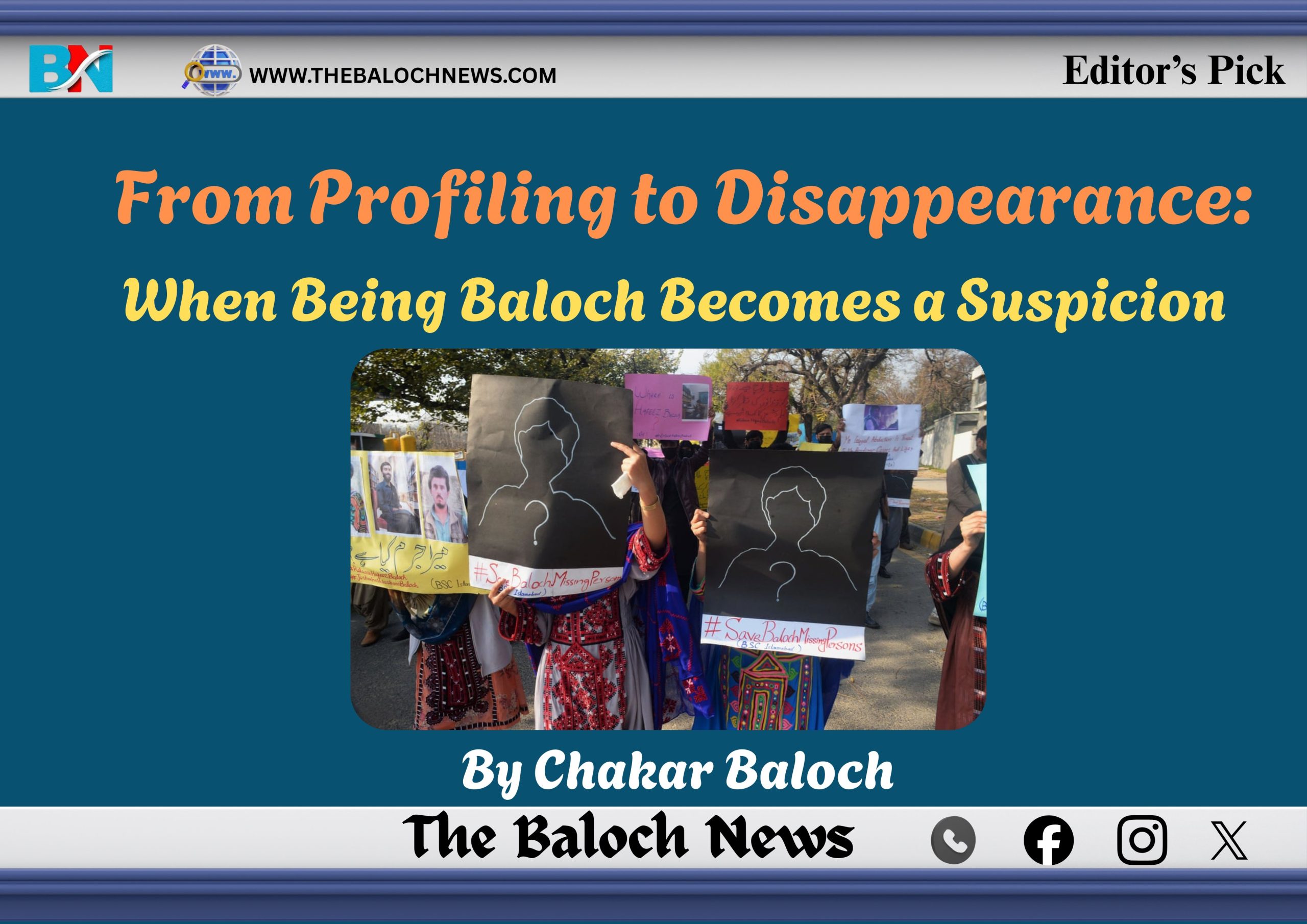
On 24 February 2026 Baloch students of Punjab held a press conference accusing that they were systematically being targeted only because they are Baloch. They were not militants, not armed participants, not fugitives but students of the university. Men and women young enough to get a degree, write thesis, take exams, aspire to careers. Their accusation was both straightforward and chilling: their ethnicity was all that made them the objects of being looked at. The question that echoes is unavoidable: Why are students being profiled?
The timing is not accidental according to some. According to the observers, the level of suspicion of Baloch people who are not in the province of Balochistan seems to increase whenever the insurgency in the country intensifies. The issue here is whether this correlation is policy or perception which is worth investigating seriously. However, to students who are subjected to constant interrogation or being monitored the difference is academic. What they feel is fear.
Awareness is created through education. Consciousness generates enquiries. And questions are able to disturb power structures. The baloch students in large cities with universities can be described as politically mindful, social-conscious and discussing rights and representation. Regimes that are nervous about dissent have, throughout history, not approached intellectual minorities as contributors, but as a threat.
The criticism was followed under the rule of Benito Mussolini, who sedated or sent to prison those who did not agree with him, as opposing the regime was considered betrayal. The Nazi Party in Nazi Germany was used to target the intellectuals and minorities by first branding them as internal enemies. The trend was fatally well-known: to ostracize, to alienate, to subjugate. The point of bringing these pasts on board is not to simplify situations. It is to remind us how easily suspicion when it becomes institutionalized can go down a dark road. The Karachi incidences that have been experienced recently have intensified that discomfort. News reached Golimar on 18 February 2026 that a 26-year-old Baloch youth, Hamdan had been killed during his time in the custody of the Counter Terrorism Department (CTD). Law enforcement officials subsequently said that he had died in a gunfight in a terror attack in Shah Latif Town. His family denied the statement, and demanded that the court should investigate what they termed as a simulated event since he was already in custody.
When one of the young men who died in custody is covered with two contradictory stories the truth is lost under the mistrust. Contested custodial deaths particularly singly harmed more than just one family. They break people’s trust.
And then there is the silence.
Then there were also reports of 3 students, one among them a student of NUML University in Islamabad being abducted in Karachi the next month. Thereafter, as it is alleged by families and peers, no details have been made known of their whereabouts. No formal clarity. No closure. Simply a vacuum that is becoming more and more oppressive every day. Enforced disappearance does not simply involve the physical taking away of someone. It is the deprivation of certainty. It puts families into suspended grief that cannot grieve, cannot hope, cannot move on. It makes mothers into detectives, fathers into supplicators and peers into justice fighters.
It is not an overnight process of disappearance after profiling. It is incremental.
First comes the label: potential threat.
Then the questioning: routine inquiry.
Then the surveillance: precautionary measure.
Then the detention: security necessity.
And sometimes in the darkest cases the news report that speaks of an “encounter.”
College children must be arguing, not justifying their right to live without being judged. A learning room is not supposed to be an inspection point. A library must not be like a watchlist. In case a state wants to be stable on the long run, losing educated youngsters is risky policy. To profile a whole race is to weaken a country instead of making it stronger. Harassment does not encourage loyalty, but discourages integration. And silence rounding disappearance augments preexisting injuries.
Opinion article is not capable of giving judgments. Courts must determine facts. Enquiries should prove responsibility. Yet the society needs to pose the ethical questions.
Why identity is something to be suspicious about?
Why do awareness turn to be objects of fear?And why should families be pleading to know what happened to their children?
The experience of history is, that when the intellectual voices are dealt with as danger, they contraction rather than expansion takes place. Countries cannot become weak because students are asking questions. When these questions are suppressed, they are weakened. From profiling to harassment.
From harassment to detention.
From detention to disappearance.
That is not a path any society should normalize. But as Greek philosopher puts it, “In war, truth is the first casualty.” The strength of a nation lies not in how it controls its minorities, but in how it protects them especially when they dare to think, to question, and to speak.
The writer is a student at the University of Punjab, Lahore.