Editor’s Note: Although this editorial should have been published in a Baloch language, but considering the editorial policy, it is being published in English. Regards.
Language is a key feature in a national culture which holds in it a people’s psyche, behavior and memories. Where a nation compromises with its language, or indigenous languages, there takes birth the internal alienation. Because quitting on one’s mother language and adopting other’s means of communication is tantamount to replacing one’s national identity with the other’s. The famous writer, Rasul Gamzatov, in his book “My Dagestan”, refers to “death of a person had they forgotten their mother language and adopted another language”. Therefore, in any nation that is colonized, among the very other forms of resistance, a key one is “Cultural Resistance” which is to ensure your culture, including language or languages, are secured. Because the colonizer, along with plenty of their psyches, try to build in the indigenous people their psyche and a replacement of ‘resistance’ with ‘acceptance’, for which they keep targeting a nation’s culture, particularly the language(s).
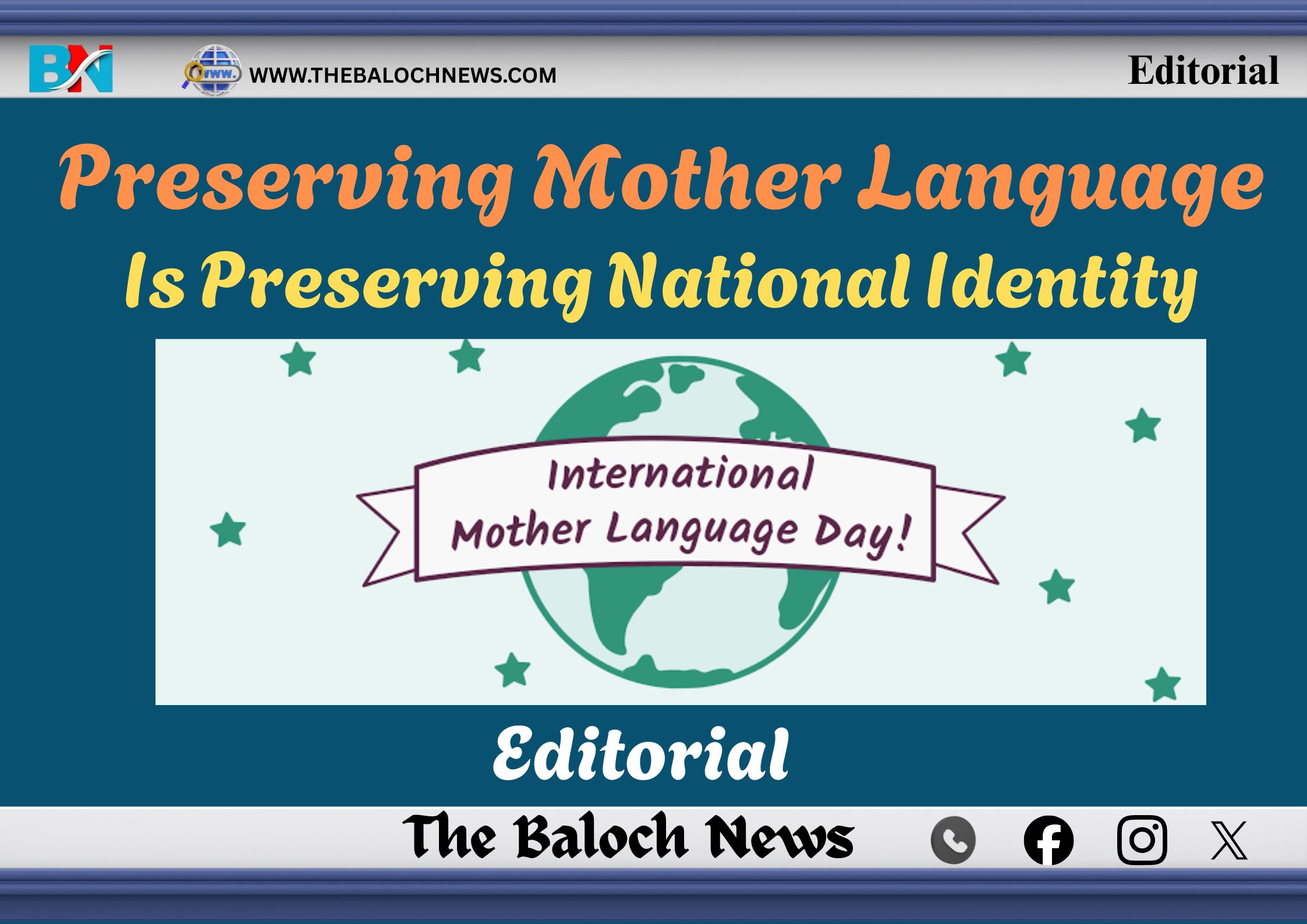
February 21 is globally observed as International Mother Language Day (hereinafter referred to as IMLD), tracing its roots from the Bengali’s struggle, which was the then East Pakistan, against the West Pakistan. On February 21, 1952, students of University of Dhaka and other activists were assassinated and injured by the indiscriminate firing of the police during a protest for the recognition of the Bengali language as the official and national language. After their consistent struggle and sacrifices, Pakistani authorities were compelled to adopt Bengali as an official and national language in 1956 along with Urdu.
The United Nations Educational, Scientific and Cultural Organization (UNESCO) acknowledged the sacrifice of the students and activists of Dhaka during the then period and formally recognized to observe Feb 21 as the IMLD in 1999, while it was endorsed as a resolution in the United Nations General Assembly in 2002. For the very first time, the ILMD was formally observed in 2008 globally and since then, it has been a universally recognized day to honor the blood shed by the Bengalis for their language.
Similarly, Baloch languages, including Balochi and Brahvi, have been intentionally demoralized by giving them no mandate in institutions. Despite the fact that scientific researches prove children’s cognitive development increases when taught in schools in their first language, the mother language, Baloch are being deprived of the very same right and are, instead, taught in government schools in Urdu and English in private schools. Apart from education, the Baloch languages are degraded in higher level of studies and further in practical life. The deliberate act to downtrod the indigenous Baloch languages is nothing more than creating Baloch national identity crisis had it not been the case with only Balochistan, while we see the other first languages implemented in rest of Pakistan. In fact, we have observed an attack on Balochi books during Dr. Malik’s reign in 2013, which was nothing but the same forced lingui-distinction formula.
This day, February 21, is a reminder that a nation can only succeed when they are deeply connected to their roots, and the roots are always found in one’s culture. Therefore, securing your culture, including your language(s), is resisting for your national identity. May we see glory coming for Baloch languages!