
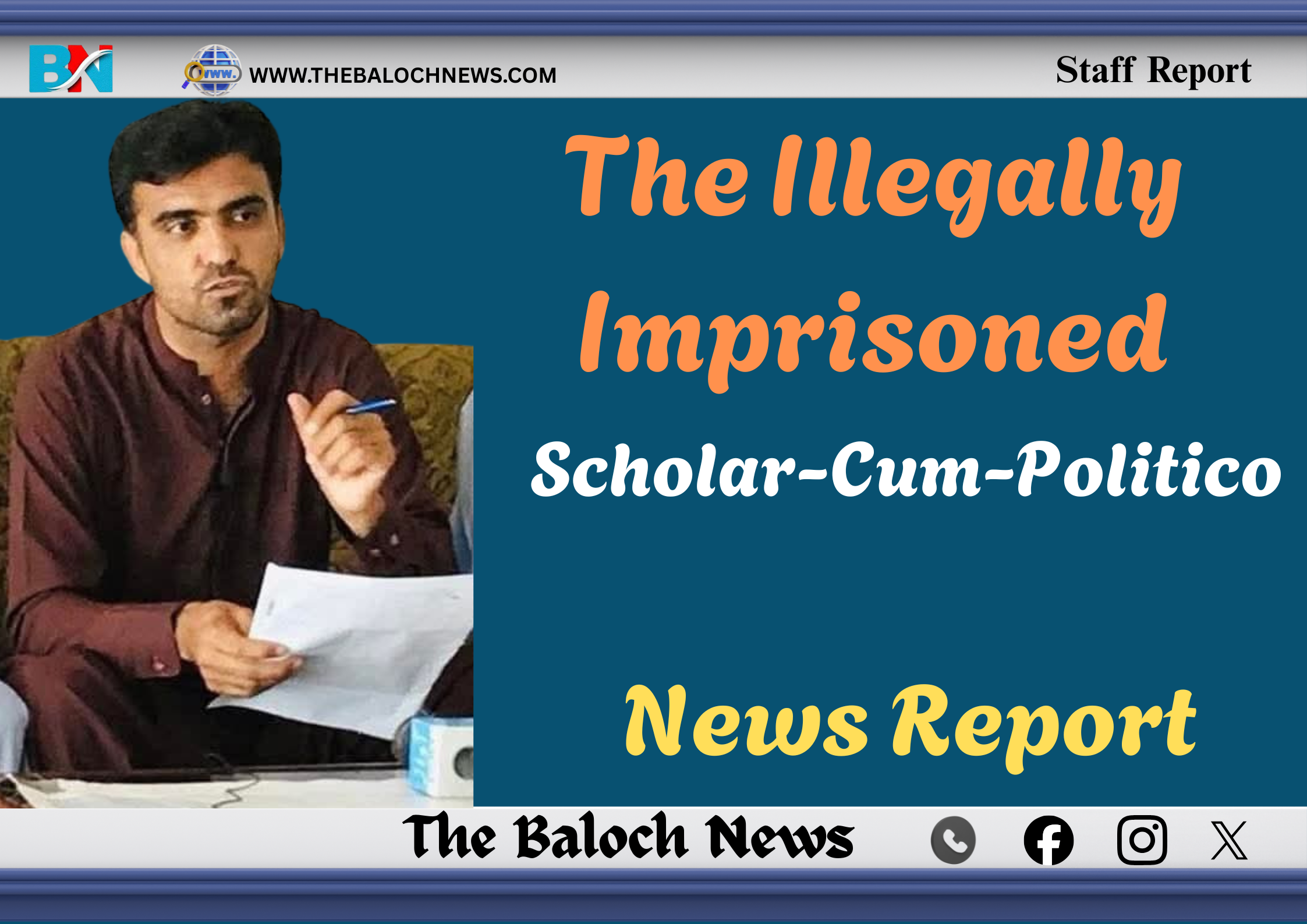
Balochistan is home to enforced disappearances, allegedly at the hands of the Law Enforcement Agencies (LEAs), most likely based on the Baloch national identity, as indigenous people claim. Over the past two decades, we have observed several political workers from disparate backgrounds going disappeared with either unfavorable traces, like torturing to death and dumping bodies in desolations and open spaces, releasing them mentally unstable and physically tortured or killing them in fake encounters or staged bomb-blasts and dumping them in mass graves; or, on the other hand, a lot of them remain untraced until now. Among several new names in the outnumbering list of enforced disappearances in Balochistan, we have Ghani Baloch, a Baloch scholar and the Central Organizing Committee member of the National Democratic Party (NDP), a Balochistan-based political party, who was forcibly disappeared by the notorious LEAs when he was on his way to Karachi from Quetta on May 25, 2025, without any surfaced legal charges. Since then, he has been shifted to an unknown whereabouts – perhaps facing torture at its worst.
Who is Ghani Baloch?
Presently, Ghani is the Central Organizing Committee member of the Baloch-centered party, National Democratic Party (NDP). He has previously served as the Central Vice Chairman of the student-led Baloch Students Action Committee (BSAC). He has been enrolled in M.Phil from Balochistan University in the Brahvi Language Department. He is himself a researcher and a writer, who is usually engaged in critical debates about the Baloch affairs, including his observant eyes on the development of Baloch politics and intelligentsia.
Because of his growing interest in education and politics, he preferred to develop his self-business – that too in an area where he could not feel disturbed in continuing his struggle for societal development. Therefore, he chose to enter into the business of books and publications. Ghani has established his own publications and book house through which he is doing both, making his survival and promoting the book-cum-debate environment in the society. With his disappearance, there has been a book-culture frozen, and a political man caged for his pure and societal developing acts and intentions.
What was Ghani doing?
Ghani was usually in his books store in Quetta, who had then established his publishing house in Karachi, under the name of Zawar Publications and Books House. He was usually staying in Quetta or Karachi for his work. Other times, he was participating in politics under the banner of NDP. His surrounding was filled with people from all walks of life: students, teachers, professors, politicians and people from every other walk of life who had a connection with books in one way or the other. You would never see him sitting idly: he was either reading a book or trying to make out a new debate on the contemporary politics and its weaknesses.
Other times, he was searching for new books to print and introduce in the market which would benefit the society at large and the way we looked at the struggle, politics and our role in societal building. He had already several acknowledged books in the pipeline for publication, while he was in constant search for newer ones. Every time a book fair was to be organized across Balochistan or in the other parts of Pakistan, one would see Ghani sending his books with as much discount as he could. Perhaps, all he wanted was the Baloch students and others be engaged in book reading and making greater use of them in their practical lives for the collective welfare.
Other times, he was engrossed in writing. He has published several articles for online magazines and newspapers where his focus was the contemporary politics and the weaknesses in the collective policies. One would always find him a critical voice who, in almost every of his written piece, was critically analyzing the policies and putting forward several approaches to deal with the shortcoming. In fact, one would never found him – whether in his articles or practically meeting him – disappointed despite the fact that he was among those who would identify the mistakes and suggest favorable solutions.
Incident of his abduction and its impacts:
On May 25, 2025, Ghani leaves for Karachi from Quetta in the evening from a private bus company. At around 10 in the night, when the bus was about to reach the Qadri Hotel in Khuzdar for dinner, prior to that, the security forces stopped the bus at around 3 to 5 kilometers earlier. They entered the bus and asked him to come down, after which they directed the bus to move leaving Ghani behind with the security forces. Instead of lodging an FIR against him and producing him before a court of law, he has been kept detained illegally without even informing his family members who are facing severe trauma of his unknown whereabouts.
Ghani’s abduction is, in fact, a direct attack on the development and intellect of the Baloch society. Apart from the trauma the society is going through after his detention, it is leaving a bridge broken to fill the gap between the state and the Baloch masses. It is also an indication that peaceful political activities are at a bar, with the clear hands of the opportunist and war-lord parliamentarians in the process to ban the politics-for-masses who choose the politics-for-self-gains.
Is there a solution?
Enforced disappearances are not new. With the new century, we have, however, observed an increase in such cases across Baloch areas. From long marches to hunger-strike-till-death, protesting sit-ins and turning to federal capital to knock every available door for justice, Baloch have left no stone unturned to trace their loved ones behind state dungeons. But all they faced was only disappointment, because no state institution – legislature, executive and judiciary – is interested in resolving the mentioned issue.
However, what has been productive is the self-support – to resist the enforced disappearances in any way possible. It can be participation in media, joining a protest or doing any other thing to record the protest for Ghani Baloch and every other Baloch who is facing illegal detention. We have to understand that enforced disappearances are a collective national concern which will affect every other home in Balochistan if not resisted wholly and unconditionally.
The state is dealing Balochistan with the policy that “Baloch are never our concern but the Baloch land and resources are” for which we have to raise in every possible means to safeguard our national future. Though promised by the contemporary Chief Minister of Balochistan, Sarfraz Bugti that “the issue of enforced disappearances would end by February (2026)” with the formation of concentration centers and families would be allowed to meet the detainees, we have observed an increase in such cases. Ghani Baloch and thousands of other imprisoned Baloch detainees wait for timely release. The scholars best deserve and serve outside illegal prisons.