
Many scholars trace the modern practice of enforced disappearances to Adolf Hitler’s “Night and Fog” decree of 7 December, 1941. This order institutionalized a systematic method of secret detention, torture, and extrajudicial killing aimed at eliminating individuals considered threats to the security of the Reich. Under this policy, designated persons were abducted and transported to Germany under the cover of darkness for interrogation and military trials. Contact with family members was strictly forbidden, and the fate of detainees was deliberately concealed. As a result, thousands were killed without any official acknowledgment. Estimates suggest that between 7,000 and 10,000 individuals were subjected to this policy.
Similar practices were later employed by Joseph Stalin during the Great Purge of the 1930s and subsequently replicated by military regimes in Latin America. Likewise, French colonial authorities adopted comparable methods in Algeria during the 1960s, using detention, torture, and disappearance to suppress resistance movements. In many cases, severe torture resulted in death, and bodies were deliberately concealed to avoid public scrutiny. These patterns demonstrate a historical continuity in the use of secret detention and extrajudicial killings as tools of political control.
During the dictatorships and civil wars of the 1970s and 1980s, enforced disappearances became a defining feature of repression in Latin America, particularly in Argentina, Chile, Cuba, and Guatemala. Governments systematically abducted individuals perceived as threats to state authority, often bypassing legal procedures entirely. The Guatemalan Historical Clarification Commission (CEH) reported that more than 200,000 people were killed or went missing during the internal armed conflict, including approximately 45,000 forcibly abducted individuals, the majority of whom belonged to Indigenous Maya communities.
Besides that, the Middle East has also faced persistent human rights violations. In several countries, large numbers of individuals, particularly political dissidents, activists, and members of marginalized communities, have been abducted by state or armed groups, with their whereabouts concealed and legal protections denied. The Office of the United Nations High Commissioner for Human Rights (OHCHR) has condemned the situation in Syria, reporting that tens of thousands of civilians went missing during the 13-year civil war under the regime of former President Bashar al-Assad.
In this broader context, South Asia has not lagged behind other regions. Over the past two decades, an estimated 118,000 cases of enforced disappearances have occurred across the region, many of which remain unresolved.This persistent pattern reflects the failure of accountability mechanisms and the prolonged suffering of affected families.
Sri Lanka is considered one of the most severe cases. It ranks second globally in the number of disappearances, with 6,264 cases recorded by the end of 2024. Amnesty International reports that between 60,000 and 100,000 individuals have gone missing since the 1960s. Due to inadequate domestic investigations and accountability efforts, the Human Rights Council has adopted nine resolutions on Sri Lanka since 2012, underscoring ongoing concerns regarding justice and human rights protection.
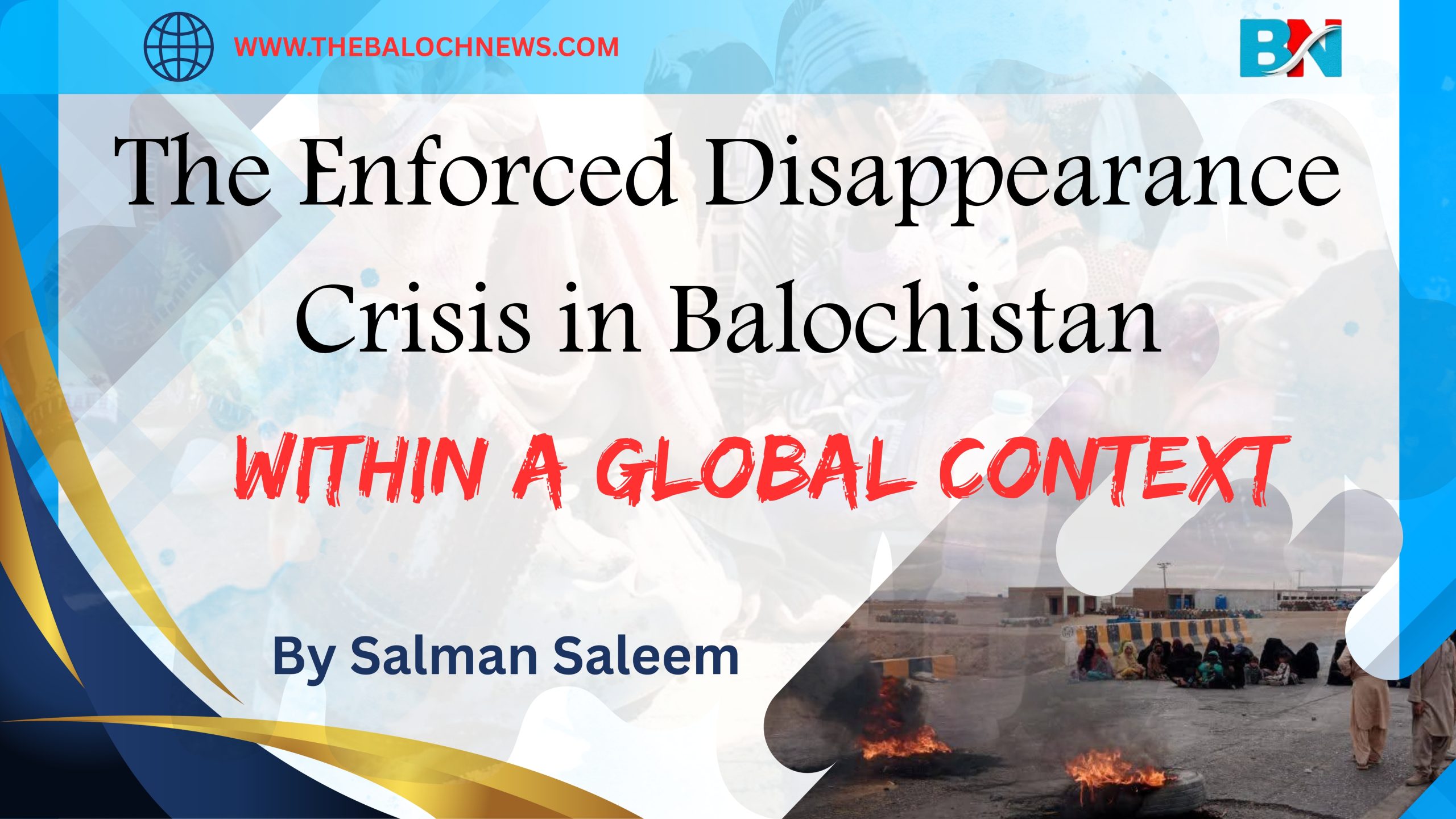
Within South Asia, Pakistan stands as one of the most persistent cases of enforced disappearances, particularly in the context of the post-2001 “war on terror”. But in Balochistan’s context, the enforced disappearance issue has always tried to be portrayed with a false narrative by the central and provincial governments. According to Farid Ahmad Khan, Secretary of the Commission of Inquiry on Enforced Disappearances (COIED), the Commission received 10,618 cases between March 2011 and August 2025. Of these, 3,627 cases originated from Khyber Pakhtunkhwa, 2,888 from Balochistan, 1,852 from Sindh, and 1,761 from Punjab. Differences among official datasets reveal limitations in state reporting mechanisms and raise serious concerns about underreporting, data verification, and institutional transparency.
Consequently, the actual scale of disappearances in Pakistan is widely believed to be far greater than reflected in official figures. In this regard, a proposed amendment to the Penal Code submitted by the Ministry of Human Rights on 7 June 2021 failed to meet international legal standards and ultimately lapsed in the Senate.
At the provincial level, official narratives have consistently sought to obscure or downplay the gravity of the issue. Government records acknowledge approximately 2,700 cases of enforced disappearances, claiming that around 2,200 have been ‘resolved’, while 468 individuals reportedly remain unaccounted for. Authorities maintain that the remaining allegations are exaggerated and deliberately intended to discredit state institutions. Official sources further assert that large numbers of Baloch have voluntarily migrated abroad, claiming that 35,000 have moved to India, 500,000 to the United States, and 100,000 to the United Kingdom, with others relocating to Afghanistan and Gulf countries. Such narratives are repeatedly circulated through official statements and amplified on social media platforms. However, human rights advocates strongly reject these claims, arguing that the true scale of enforced disappearances remains deliberately concealed within what they describe as the ‘dark corners’ of state practices.
In contrast, the Voice for Missing Persons and Victims (VMPV) estimates that over the past two decades, more than 45,000 Baloch individuals have been forcibly disappeared. Nearly 5,000 are reportedly killed, with their bodies discarded. Only a small number of abductees have returned home, many suffering severe psychological trauma. Victims include students, businessmen, drivers, laborers, and other civic actors primarily individuals who have spoken out for their civil and political rights.
According to a BCC report (2016), in 2011 alone, more than 936 mutilated bodies were reportedly found dumped across various locations in Balochistan. On 25 January, 2014, three mass graves were discovered in Tootak, a village in Khuzdar District. Local residents claimed the graves contained 169 bodies, although only 15 bodies were officially retrieved. Additionally, a mass grave uncovered at Kaasi graveyard in Quetta recently, reportedly contained dozens of bodies. These findings are widely cited as evidence of an alleged kill-and-dump policy, particularly following the hijacking of the Jaffar Express train, after which numerous disappearance cases were reported.
A comparative district-level analysis covering the period from 2011 to 2024 indicates that only about 30.4 percent of forcibly disappeared individuals were eventually released. Nearly 70 percent remain missing, were killed, or their fate remains unknown, leaving families trapped in prolonged uncertainty and suffering.
The crisis in Balochistan is rapidly taking on a genocidal face. Every day, people are abducted from their homes, public places, and check posts without any legal procedure or due process. Within this year alone, many women including minors have become victims of enforced disappearance, with no information provided about their whereabouts. Their families are left in unbearable anguish, protesting and pleading for the safe return of their loved ones. Yet their heart-wrenching voices fall on deaf ears: neither international human rights defenders nor influential professional bodies have taken meaningful action. It appears as though a silent war has been imposed on the people of Balochistan, collectively punishing the residents of the province without evidence, trial, or justice.