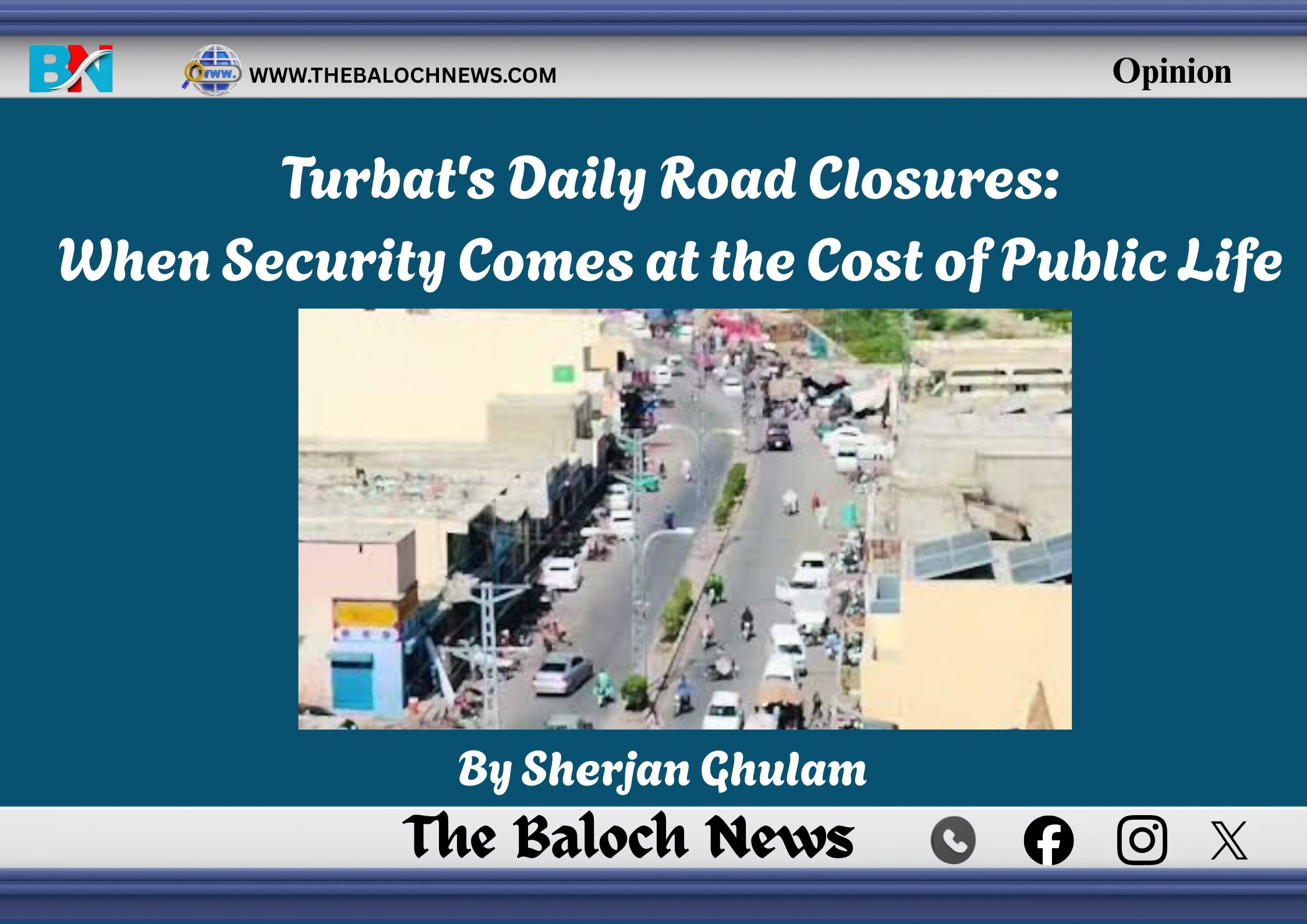
Turbat, the administrative centre of Kech district, has increasingly become a city where travelling from one place to another has turned into an unpredictable struggle. Repeated road closures, security restrictions and traffic blockades have disrupted people’s ordinary life, raising serious questions about the balance between public safety and citizens’ fundamental rights.
Road closures are not entirely new to Balochistan. However, their repeated occurrence in Turbat has become a growing concern for residents. Students, patients, government employees, traders and ordinary commuters often bear the consequences of restrictions they have little information about.
The situation became particularly concerning on September 4, 2026, when The Balochistan Post reported that road restrictions in Turbat had disrupted movement for four consecutive days during a visit by “social media influencers” from outside Balochistan. Doctors, paramedics and patients reportedly faced difficulties reaching Turbat Teaching Hospital. Medical staff subsequently protested against the restrictions and alleged mistreatment.
Similarly, on September 21, 2026, Dawn reported that a protest organised by All Parties Kech demanded an end to road blockades and restrictions affecting commercial activities, markets, courts and hospitals. These developments demonstrate that the issue extends beyond traffic congestion; it has become a matter of public access and civic rights.
The consequences are particularly serious for patients. An ambulance delayed by a roadblock can mean the difference between timely treatment and a medical emergency becoming fatal. Students risk missing examinations, employees lose valuable working hours, and daily-wage earners may lose an entire day’s income. For an ordinary citizen, an unnecessary road closure can turn even a short journey into hours of frustration.
Security concerns in Balochistan are real and cannot simply be ignored. Authorities have a responsibility to protect citizens and prevent potential threats. Nevertheless, security arrangements should not unnecessarily turn public roads into barriers against the very people they are meant to protect.
The solution does not require abandoning security measures. Instead, the district administration and security institutions should adopt a more organised approach. Alternative routes should be announced in advance whenever roads are to be closed. Ambulances, doctors, students and other essential commuters should receive priority passage. Security checks should be conducted efficiently, without keeping entire neighbourhoods waiting unnecessarily.
Ultimately, Turbat deserves both security and normal civic life. Its residents should not have to choose between reaching a hospital, attending a classroom and fulfilling their daily responsibilities. Security is essential, but public convenience, dignity and freedom of movement must also matter. A road is built to connect people, not to keep them waiting indefinitely.