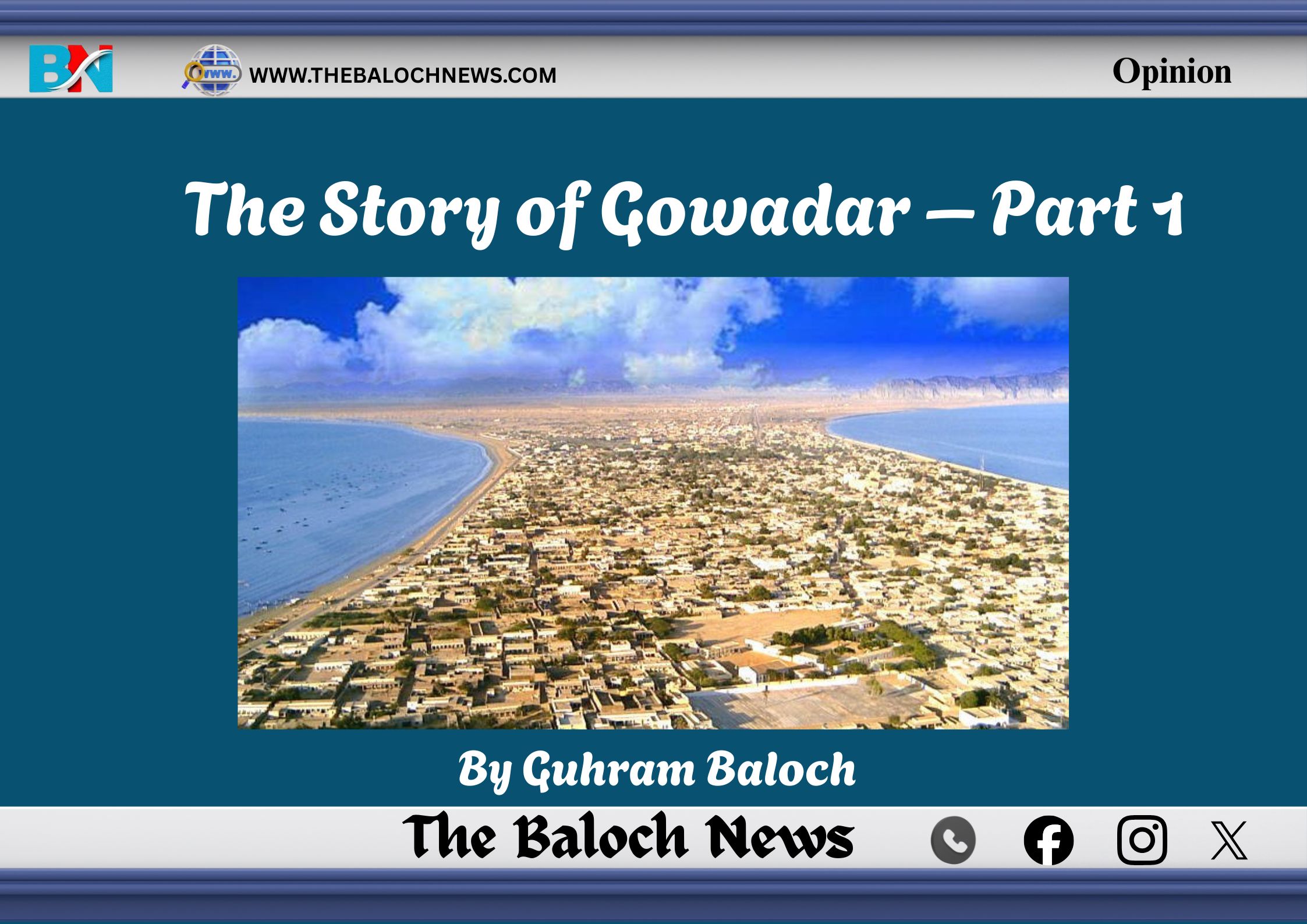
This interaction with KB Firaq is a part of a series of interviews with people in Gowadar
The Arabian Sea, also termed as the Baloch Sea in the Baloch areas, has very immense political, economic and social significance for the regional and global actors. For centuries, it has been under the evil’s eyes. Until now, as Selig Harrison claimed back then in his book “In Afghanistan’s Shadow”, that “had it not been the sea, Balochistan would have never been slave for too long”. Even now, Balochistan is facing unrest owing to its geopolitics with the sea which is a blessing but under harmful eyes. Yet for the indigenous Baloch, it is the sea they look up to and it is it which brings them up as parents.
For the Baloch in coastal areas, fishing has not only been an economic activity but their own dignity and honor. As it is widely circulated among the indigenous people that “if life gives me another opportunity, and if I come into this world again, then there is no better identity for me than to become a sailor/fisherman or to pursue sailing/fishing as a career”. And the people obey by their ancestral mode of income generation which they believe to define their identity and dignity.
“I think fishing is something that is bound to my personality and has maintained continuity with my way of my living,” says KB Firaq, a poet, writer and a local activist. He believes that the indigenous people in the city have always considered fishing on the sea more than a “government employment” which is why they never looked up for employment bound by duty, but believed on self-employment in sea. It is because they feel it gives them respect along with income to continue their life as they are not depended on anyone else but themselves and their Sea. “We have to do our job and live our lives on the basis of our hard work, through which we have freedom of thought, ideology, and action unlike the government employees.”
In sailing, they do not only get income, but follow their ancestral policies, one of which is the custom of “Sangaar” – which means “sharing and caring”. In sea, it is not always the case that you catch fishes, while some others catch plenty. “Sangaar is when one of the sailors has caught a lot of fishes, he shares them – particularly with those who had caught less or none.” Says Firaq, adding that this act of Sangaar has been an historic tradition followed until today. He is of the view that a people could only prosper when it had the ability to produce. “Any country is only weak when it does not have the means of production,” he said, stressing that Gowadar was potentially a great market for production if used accordingly by considering the indigenous grievances.
The indigenous people, apart from looking at the Sea as an economic opportunity, carry a very close and sacred bond with it. As Firaq says, “When a child is born, the first sweet offering would be dedicated to the Sea.” On a similar note, the first child-shaving is also practiced in dedication to the Sea. This shows how the indigenous people respect and honor the Sea. Yet they are reduced to sufferings from projects where their grievances are over-eyed and they are excluded from the decision-making process for what they believe is very sacred.
Owing to international projects, in Firaq’s views, the indigenous people have been deprived of nursery and important sea-areas for fishing. Before initiating any national or global project, there is an assessment which does not only look at the significance of the project but also observes the local population’s comfort and the outcomes of the initiative. “Take the example of Gowadar Port,” Firaq highlights one of the several examples, “the particular location where the foundation of the Gowadar Port was laid is an important fishing ground, and where a large quantity of fishes are produced, but the same is covered and barred for fishing.” He adds that the particular area has always been a heaven for marine life too, yet this area was taken over and incorporated into the project, endangering the marine life too.
Firaq strongly contends that the very area is a “natural blessing” through which, before this project, the country’s economy received a significant amount of foreign exchange through the hard work and livelihoods of these fishermen. “Be it the dam or the bar for festive, they are not as important as the Sea for the indigenous people’s ancestral fishing,” Firaq says, adding that a lack of assessment resulted in several fishing-interested locations into musing places which is concerning from the indigenous perspectives. As an alternate remedy, Firaq says, local people and notables could have been consulted in the assessment for the place selection.
When assessment is not done on priority basis with the inclusion of local people, they suffer. Just as the fishermen in Gowadar are currently anguished due to several fishing-spots turned into amusement. “As per the global customs, anywhere a project is to be launched, a proper agreement is signed with the residents of that place,” Firaq tells me. The people here have nothing but the land and the sea, he adds, if they are deprived of it, or if the very same is snatched from them, they will be left with nothing. “We are heading to a similar destiny which is both, disheartening and unacceptable.”
Another key point Firaq raises is the discourse of “development”. With an amusement park and a port that the local people have no access, the authorities tell the fishermen that “it is fine with what you are facing as we are facilitating you”. In Firaq’s thoughts, “It means you are taking everything and giving back a little of the same and thinking that the indigenous people will be happy with it and forget everything! Pathetic.”
For any people, the most important segment is protection of one’s own riches and exploiting as much as possible of the others. The minerals and other natural goods in Balochistan, or let’s say Gowadar, whether available inside water or on land, are extracted and used for the benefits of external factors more than the local ones. Firaq is a strong opponent of those involved in continuous genocide of marine livings and deprivation of the fundamental rights of the indigenous people. “Here, permission is easily given to anyone outside the city to enter the sea and kill the fishes whatever and the way their hearts want,” Firaq says, adding that because the sea does not belong to them, hence, they do not care for the creatures within it.
“But it is our Sea and we cannot let it ruin.”