
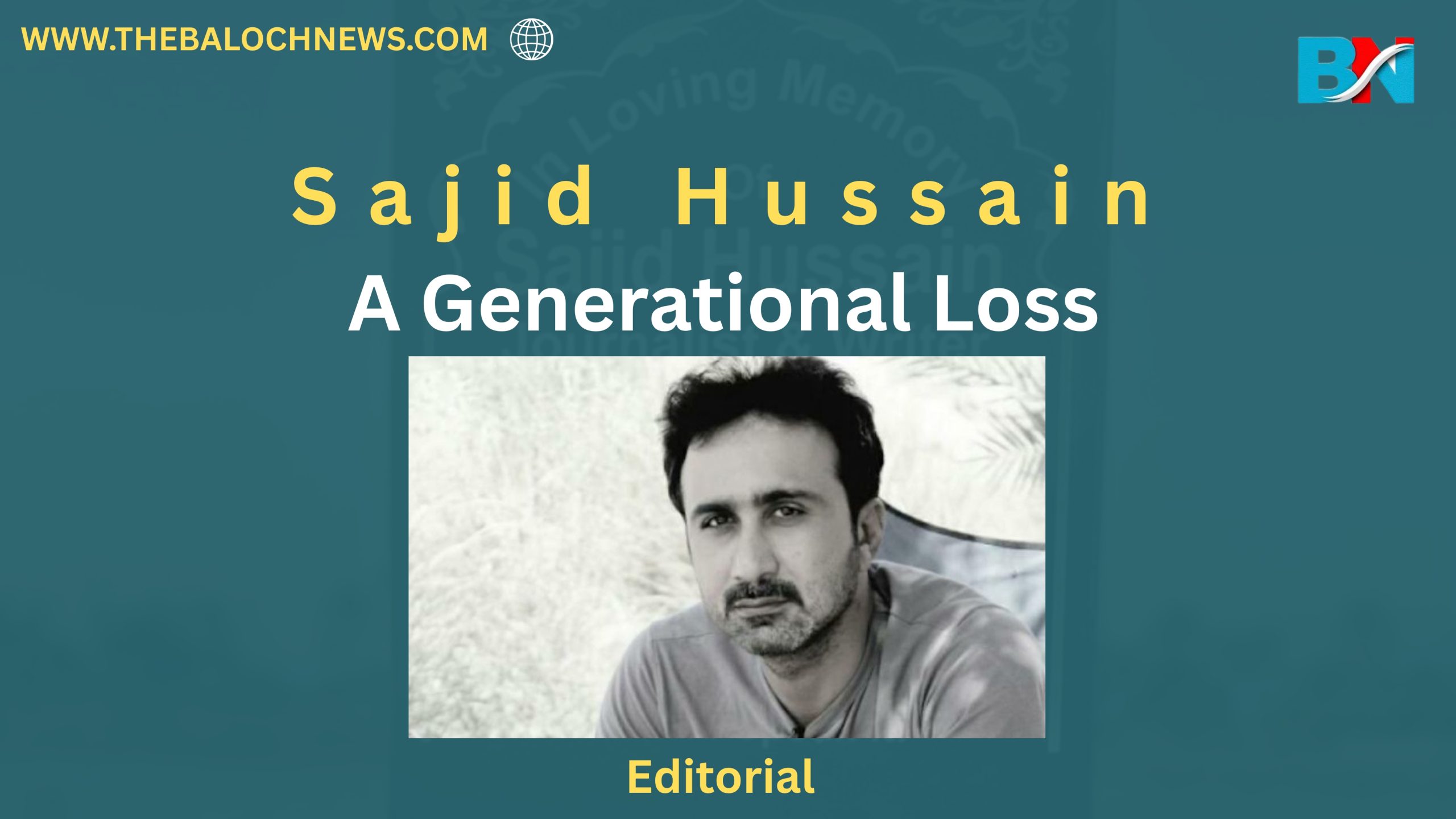
From millions of people, it is only a few who make their lives worth for the national interests. Sajid Hussain is one among the very few names who did not only light the Baloch journalism, but played a key role in the documentation of the humanitarian crisis of the Baloch and was engrossed in the standardization of Balochi language – and perhaps performing plenty other works we less/or not at all know about, including his “around 220-pages novel” yet to surface. He was also a critic – an actual critic – to the ill tasks irrespective of the performers. Because he had studied enough to keep his critic forward, he would usually receive “no answers” but to refrain from criticizing publicly. He was never going to stop though, knowing its worth and necessity to be done accordingly.
Sajid Hussain, born in 1981, was abducted by “unknown people” in Sweden’s Uppsala city on March 2, 2020 – a day Baloch celebrate across the world as “Baloch Culture Day” – only to be dumped lifeless in a city’s river on April 24 the same year. He was, at that time, working on few primary-cum-very-necessary tasks: one, he was running a website “The Balochistan Times” in English and Balochi where he was not only trying to document cases of enforced disappearances but writing on several issues and critics concerning the Baloch. He was also asking young/mature writers to contribute. In short, he was on a mission to work on critical/intellectual development of the people he could approach – a vision that was very much required.
Two, he was working on several humanitarian crises against the Baloch in documentary form. As Taj Baloch, one of his close associates, mentions, Sajid was working on a book on humanitarian concerns of the Baloch which was to be submitted to the human rights groups on a global stage. The book was scheduled for publication in April 2020 – a month before he was abducted and dumped the very month his book was to be published. Sajid believed in working on areas which required attention and for the very same, he believed, it only needed a few individuals – few honest individuals – to come along and work silently and accordingly.
Sajid went in exile in 2012 – fearing the threats inside the country. He had already lost plenty of his family members in the enforced-disappearances-followed-by-murders. Before becoming a victim himself, he chose self-exile – or better to term it forced-exile – an exile that hurt him the most. But he was a little short to comprehend that threats would follow him immediately in exile and eventually lead him to a river, lifeless.
Sajid was, nevertheless, not only writing the Baloch stories, but “living them”. As Sajid says, “Dead does not haunt as much as missing does,” he himself became the victim of ‘being missing’ for over a month before ‘being dead’ – and both, the missing and the dead hurt the nation equally.
No matter how far one has gone from the Baloch land, if they had contributed for the Baloch cause, the Baloch land the people, the Baloch land always brings them back to bury them inside its chest – just like a mother wraps in her arms her beloved child. Sajid, too, was brought back to be buried in the chest of his land – the land he worked years for – and among his people – the people for whom he chose exile. On August 7, 2020, Sajid Hussain was brought back to the country and laid down among his dearest ones in Nizarabad, Tump. Though he ends a personal chapter, but enters into a national chapter – a chapter that will last as long as the nation lives.
Rest In Power, Sajid.