
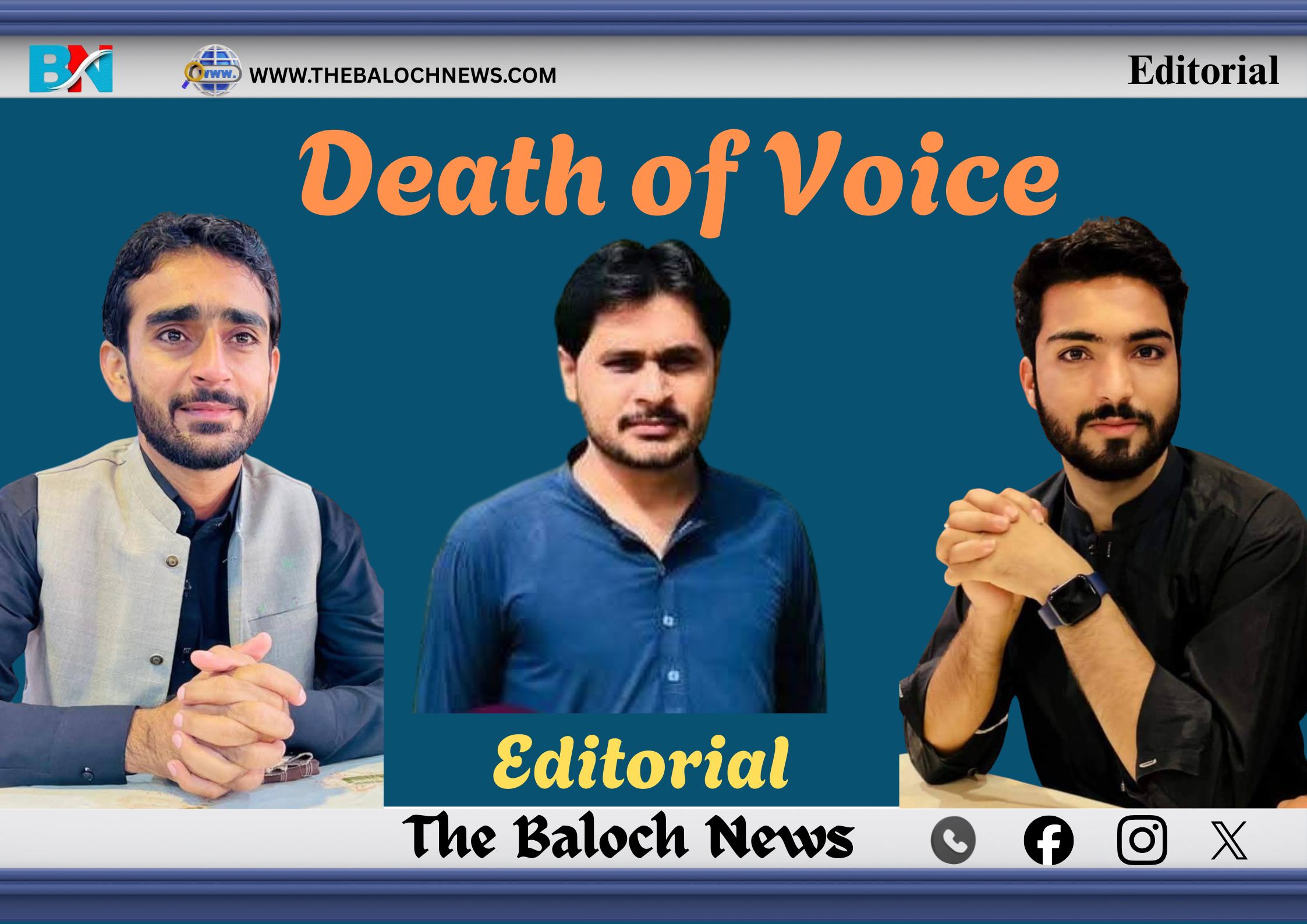
Balochistan’s longing issues no more surprise, particularly, the state-involved enforced disappearances (hereinafter referred to as ED-s), targeting civilians from various backgrounds, including teachers, students, singers, politicians, journalists, shepherds, drivers, labors, social workers and from every other walk of life, irrespective of gender, age and health concerns. Very freshly, the students have been in the limelight, let’s, for example, observe the recent abductions of three students from Karachi, named Danyal Nasir, a graduate at National University of Modern Languages Islamabad, Mohammad Iqbal and Irshad Ali, both students, who were forcibly disappeared near Neurospinal and Cancer Care Institute (NCCI) Karachi, on February 16 this year. As usual, the families visited the police station but retuned disappointed because police never lodge FIR in such matters as a precedent. In the middle, we observe a death of indigenous voices too, to be honest, either in fear or in care, or in the never-feeling need to voice or due to self-censorship.
A claim made by most human rights groups in Balochistan regarding “there is no home in Balochistan free from the burden of EDs” seems very much in line with the prolong tensed circumstances across the region. Hoping for securing one from the disease of EDs will not be more than a daydream for anyone with the “Baloch” tag. However, what makes it sounder is the united indigenous voice and resistance, whether in form of social media campaigns, challenging the institutions in the courts, or even protesting – or any other forms of resistance. As long as the victims of the EDs remain the subjects of our collective resistance, the chances of their return increase.
But what is even more concerning is the constant state institutional efforts in expanding the EDs across Balochistan without taking into consideration the consequences, specifically targeting the Baloch students. This new wave of EDs is greatly influencing the educated section who are forced to believe that “whether or not you are involved in an anti-state act, you are the new victim”. The state can engage the Baloch youth in healthy activities to restore the lost trust and build confidence in them regarding the state and its institutions, but before that, they have to ensure EDs are finished and they are treated as equal citizens. As long as they continue to disturb the youths, they will be more forced to quit on the system.
Though through threats of action, the government is trying to stop the people from peaceful political struggle for their rights and media campaigns, it will ultimately be a bigger challenge to bring back the gone-status-quo back to normalcy again. It is still not very late. The civilian-victimization, with an increasing number of students in it, can be a short-term solution to make a state narrative based on falsity, but they need to learn from the past: Baloch have already gone through a deadly-phase. All the government needs to adopt is foreseeability and intent that where they are willing, and trying, to take the situations to: peace and harmony or instability and distortion?
In the middle, responsibilities lay on the Baloch masses as a whole to remain active in taking back what belongs to them. When the state institutions, including the government, have resorted to give collective punishment to the Baloch, silence can only make it harder. Before your voice is dead and your loved ones are in danger of losing life, think twice for timely action before it is too late. Any small piece of effort make it worth and can make a change.