Balochistan, as per Pakistan’s census, has a thin population of 14.89 million people (only the areas falling in the contemporary administered areas of Balochistan under Pakistan. However, it has always been under the eyes of the foreign powers for the attributive land which has been suitable for all the seasons with natural resources and [warm] sea water – also known as the Baluch Sea. According to the historians, Balochistan (previously famous as Kalat State) was annexed to Pakistan in March 1948 (which is also referred to as “forced annexation). Since then, Balochistan has passed through various negligence from the Pakistan’s consecutive regimes, who have never been interested in bringing reforms in changing the fate of the indigenous people. One among many issues the Baloch people go through with the state institutions is mispronouncing – and miswriting – the names of the places of Baloch areas, which are written according to ‘their’ pronunciation in the legal documentation, and not how the local people pronounce them; the people disown the negligent attitude of the governmental institutions.
Makoran, a former separate state and part of the Kalat state, is written as “Makran” or “Mekran” in the official records of the government. Local people pronounce it as “Makoran” which has a vast historical background. Formerly, the state had been a well-established economic zone due to its geographical boundaries which touches borders with the neighboring Iran. In the recent age, the dates of Makoran are exported to various parts of the country and abroad. When the newly-annexed state visited the areas, they could not pronounce Makoran and fixed the name as Makran and Mekran. “It is like distorting our ancient Makoran’s name which is so apathy of the governmental bodies,” the people complain.
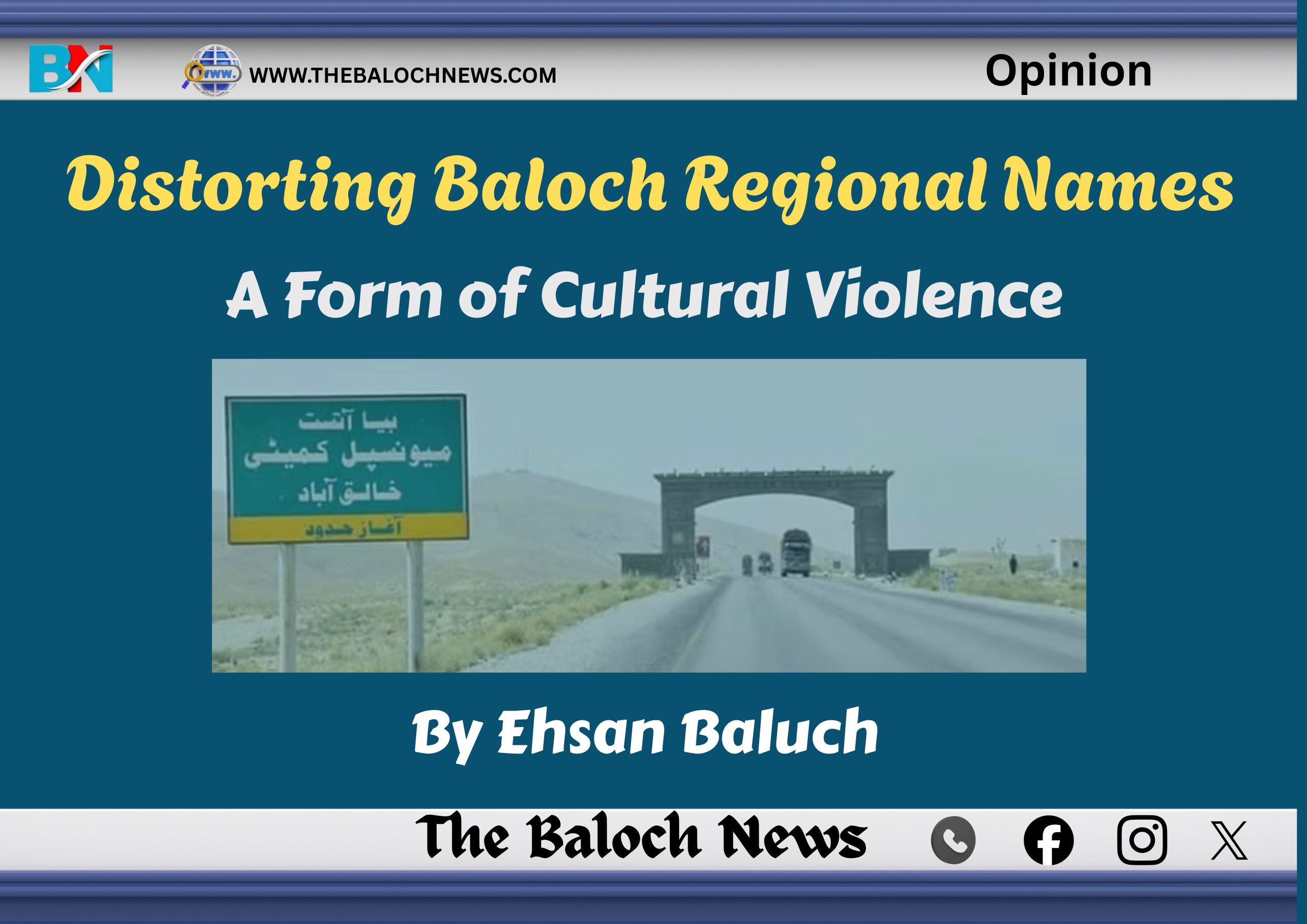
Mangochar (derived from Monge-char) which is officially written and pronounced as “Mangchar” is nothing but misrepresentation of the sense of the name. Recently changed from Mangochar to Khaliq Abad, the people out there still calls it Mangochar – the old aged people call it as Mongechar. Abdul Khaliq was the father of former National Party leader, Khalid Langove and Zia Langove. During the National Party regime, the name was changed into Khaliq Abad. Despite sheer silence from the people towards the change in the city’s name, their attitude of still calling it Mangochar describes it well that they prefer Mangochar over Khaliq Abad: however, pronouncing and writing it as ‘Mangchar’ has never been acknowledged by the people.
Hoshaap and Aapsar, a sub-tehsil and town of Kech district respectively, are converted into Hoshab (some others call it Khoshab) and Absor which entirely alter the meanings of the names of the towns. Hoshaap, a sub-tehsil and some 84 kilometers away in the east of Turbat city, has a healthy population of 52,947, covering a land area of 2213 square kilometers – reports the 2017 Census. It contains various small towns where governmental negligence has already led to severe sense of deprivation. In the given circumstances, changing the original name of the town from Hoshaap to Hoshab or Khoshab adds to the heat-heartedness of the local people.
On the other hand, Aapsar is located within Turbat city containing a large portion of land area and a thick population of the city. There are several small areas in Aapsar, including Ziarat (the historical and religious site of the local Zikri community), Kolwai Bazaar, Aaskani Bazaar and so forth. Due to the official name of the region as ‘Absor’, most of the locals – and all the other people specially people from outside Turbat – pronounce the area’s name as ‘Absor’ instead of ‘Aapsar’. Although it looks fine from surface to many people – particularly the educated class – but it concerns many other conscious Baloch residents who deem it as an attack on their town’s name – or let’s term it an attack on their identity.
Bal Negwar is a sub-tehsil of Dasht (Kech) in the west of Turbat city with a thick population comprising of more than a dozen villages. Recently, when a NADRA office was established in the town, the name was changed in the NADRA board from Bal Negwar to Balangoor which was a whole different name. Against the irresponsibility of the institution, the local people of the region went to Turbat city where they protested against miswriting and mispronouncing the actual name of the town. They also lodged a formal complaint before the Deputy Commissioner of Kech, while continue to wait for the approval.
Not only NADRA, but also the Frontier Corps (FC) personnel pronounce Bal Negwar as Balangoor which enhances the anger of the people. Despite speaking to the security personnel about pronouncing the area’s name correctly, they reacted against the people. “Once I told a FC personnel that I was on my way to Bal Negwar, he asked back that why I was going to Balangoor,” complains a local with a disheartening mood. “I tried to convince him that it was not Balangoor but Bal Negwar, but I was scolded instead of him pronouncing the name rightly.” Such an attitude from the law enforcement agencies fuels the wrath of the population.
Gowadar, the hub of “China Pakistan Economic Corridor (CPEC)”, is a city in the Makoran region of Balochistan. Due to its deep sea water, the port city is famous across the world with the eyes of the imperialist powers towards seizing the city in one or the other means. The Baloch and English historians claim that the city belonged to the Kalat state, which was given to the Oman King in the eighteenth century as a place for asylum when he and his brothers fought for the kingdom. The Oman King had the occupation until 1958 when it was annexed back to Balochistan under the control of Pakistan. Originally pronounced as Gowadar, the Pakistani records write it as Gwadar which is eventually getting place in the mouths of the people from Balochistan, Pakistan and the world as Gwadar and not Gowadar. This heats the sense of anger.
Two other such name-changing took place in a “Balochistan government” notification in September, 2025, where the Soorab district is said to rename as Sikandar Abad and Phelawagh tehsil of Dera Bugti is named after Qadirabad – Qadir Bugti is the father of Sarfaraz Bugti. Both the regions hold historical significance in the history of Kalat’s resistance and governance. The renaming of the areas, just because it matches with the interests of one person in administrative power, is a direct attack on the core of the society at large. Neither the people of Soorab nor Phelawagh have approved the names, but the government records will continue to repeat the newly assigned names which likely endangers the psyche of the people in the future.
Cultural violation includes the distortion of the ancient and locally pronounced names of materials and places. Although they keep little bit of influence in the everyday life, but they have long-lasting impacts culturally, psychologically and nationally. The tiny blocks can lead to snatch from a nation its identity and existence. Several social media campaigns were run considering the distortion pf the names of the Baloch regions to be called and written as they are and not by how the foreigners pronounce it, but all in vain. These names do not come alone, but bring with them a psyche of the oppressors.
What it actually clarifies is that Kalat State has always been a different region – never a part of the sub-continent – considering the change in language group, psyche, culture and standards of the people. However, before the Baloch-tensions materialize following the change of the Baloch regional names – as part of Cultural Violence – the indigenous people need to resist before it is too late.