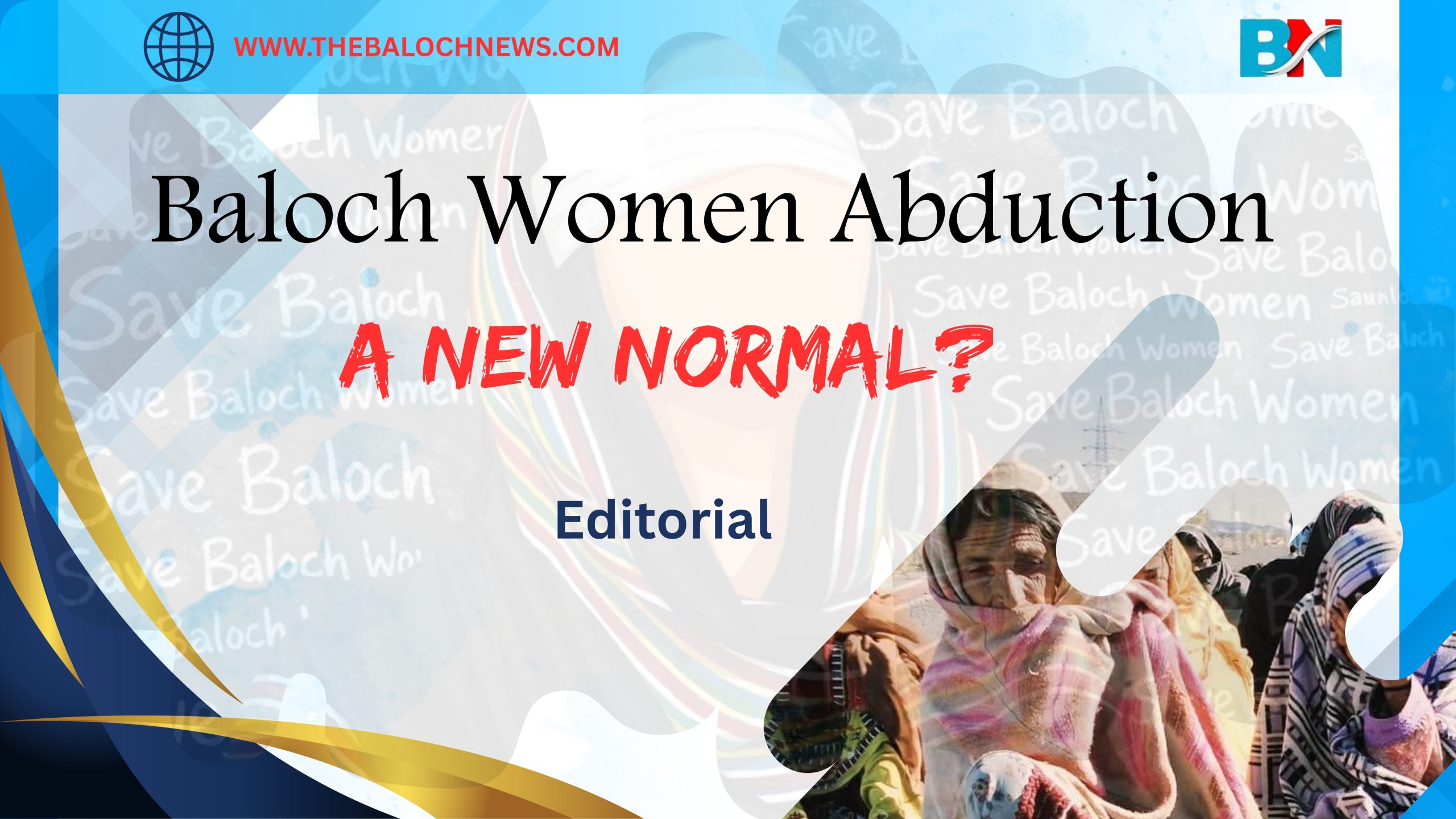
The enforced disappearances of Baloch women roots back to 1970s when two Baloch women, Bibi Soomari and Peeradi were illegally abducted from Jhao area of Awaran by the security personnel. The series of the ongoing repression largely shifts to the Baloch men. However, in the contemporary circumstances, Baloch women are dragged into the heinous crimes, specifically of the enforced disappearances, along with the Baloch men. In the ongoing year, 2025, we witnessed a rapid growth in cases of women abductions and “confidence” in state institutions to do the same without hesitation, which has raised concerns among the indigenous masses.
Enforced Disappearances: A Longstanding Issue in Balochistan:
Enforced disappearances have greatly influenced Balochistan, due to which the region is also referred to as “home to enforced disappearances” allegedly by the hands of the “law enforcing institutions”. The abductees are kept in “illegal torture cells” for months and years without receiving a chance to defend themselves formally before a court of law: sometimes, they are lucky enough to return home – though with traumas of mental and physical torture – and other times their lifeless bodies are dumped in desolations, mountains and, unfortunately, these days inside cities and towns with allegations of having them murdered in encounters – what is locally termed as fake encounters.
Giant names are yet missing, which include Dr. Deen Mohammad Baloch, Zakir Majeed Baloch, Zahid Baloch, Asad Baloch, Shabir Baloch, Rashid Hussain Baloch and an outnumbering list of what Voice for Baloch Missing Persons (VBMP), a Balochistan-based group working on documentation of cases of enforced disappearances since 2009, believe to be in thousands. As a counter argument, the state representatives, directly and indirectly, term those enforced disappearances as “self-disappearances” in public, while during in-camera meetings and families’ visits to them, they give them a “false hope” of trying their best to “talk to the authorities” to ensure they are “not tortured and released soon”.
Women Victimization: A Chapter That Continues to Grow:
Women victimization is a prolonged world dilemma, but things were easier in Baloch regions. Where feminism movements were at their peak across Europe, America, and other empires and states – generally termed as “developed states” – Baloch women were enjoying and preaching equality, equity and peace irrespective of gender. Banadi’s leading role in Delhi war in 16th century is one such account which bridges the gap of argument for women’s rights status in the former Baloch state. However, the rights continued to curb with the arrival of English invaders, followed by the recent annexation with the state of Pakistan in March, 1948.
One among various forms of women victimization is the trend of enforced disappearances of Baloch women, which roots back to 1970s, but has found a surge in the ongoing year, 2025. Only in the year of 2025, there have been around twelve reported cases of women abductions – with five of them taking place only in the month of December – as recorded by the Human Rights Commission of Balochistan (HRCB). This shows that the women disappearances, just like the Baloch men, are en route to normalcy.
Women Abductions: A Cultural Violation:
Baloch society renders great respect and honor to women. Even in harsh situations, as wars, women are exceptions and their presence results in end of the war. However, since Balochistan’s merger with the state, situations have changed. There have been continuous dishonor to Baloch women allegedly involving state’s institutions which is widely referred to as “Cultural Violation”. For example, during illegal raids, the security personnel enter homes without warrants and by “breaking into houses” during nights. They do not care of the women and continue their part of barbarity – without justification, accountability and a sense of honor and respect.
The latest step is victimizing the Baloch women directly with the heinous crime of enforced disappearances which is directly an attack on the core of Baloch culture. When illegally arrested, the personnel do not disclose their locations, neither do they produce them before a court of law. This shows that the forced disappearances are, apart from hurting the state’s international commitments to uphold fundamental human rights, which include the respect of culture and free and fair trial, and dignity of citizens, are also violating the indigenous Baloch culture.
Response to Women Abductions:
The families of Hani Dilwash, who is in the final phase of her pregnancy, and Hair Nisa (17) blocked the CPEC road from Karki, Kech, on December 23, when Hani’s brother, Mujahid Dilwash also fell prey to the heinous crime of enforced disappearances from his home. The family of Fareed Ijaz, who was abducted on December 19, 2025, also joined the sit-in. The protest ended on the third day, on December 25 in the late evening when negotiations succeeded: the authorities ensured all the detained persons would be released within a week. The road was cleared for traffic afterwards.
Apart from this, Baloch Women Forum (BWF), a Balochistan-based political entity, has raised its concerns over the surge in women disappearances, calling them a pattern of “collective punishment” adopted after “failing state policies” in Balochistan. They also allege that women’s disappearances are followed by “asking for ransom” from the families to release them. They also called for “state-level and international interventions” on urgency to “cease further Baloch women suppression”.
Baloch Yakjehti Committee (BYC), another political group in Balochistan, called for a five-day campaign against the surge in enforced disappearances of Baloch women, which began on December 22, 2025. The 5-day campaign includes an online petition, statements and video messages, art as resistance, symbolic protest and a webinar to be held on December 26 as the culmination of the campaign. They also term women disappearances “a direct attack on the dignity, survival, and collective identity of the Baloch nation”.