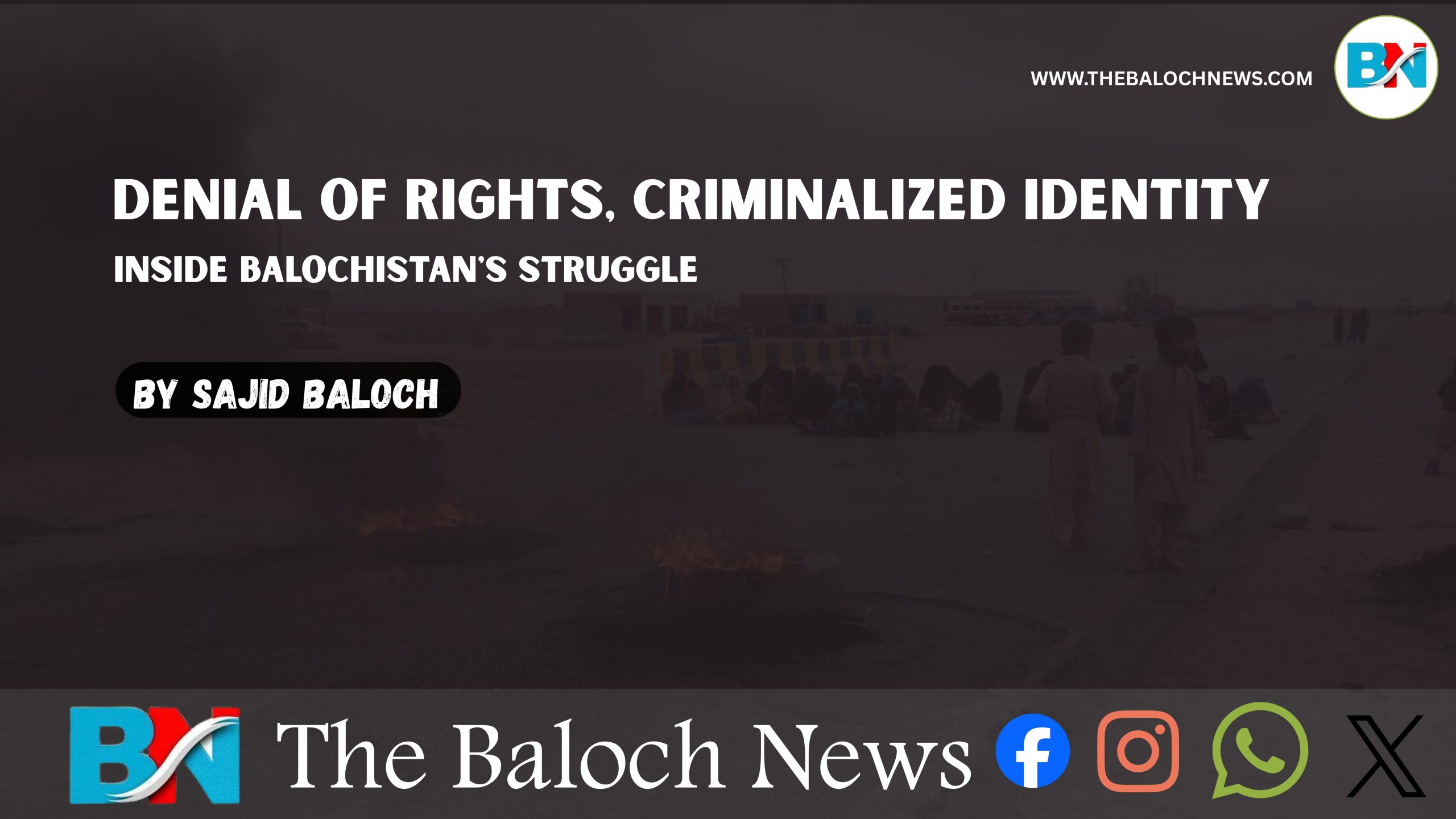
The day Balochistan became part of Pakistan, amid governance and stability challenges, the state administration began the denial of rights, the criminalization of identity, and crackdowns on leaders. Baloch intellectuals and leaders from different fields including writers, human rights activists, teachers, doctors, and students started their struggle and tried their best to work for the Baloch issues. In this ongoing situation, many activists were taken into custody, and some were tortured by the state agencies. The reason behind this discourse lies in the tactics the state uses to eliminate social change.
Baloch people face several restrictions on their basic freedoms, such as freedom of speech, the right to life, the right to free and impartial trial, the right to dignity, and others. Even peaceful movements are often targeted. On 28 July, 2024, a gathering held by the Baloch Yakjehti Committee (BYC) in Gwadar was suppressed. The administration used its entire machinery to silence the voices of the Baloch. Thousands of men, women, and minors participated in this event. People from every corner of Balochistan were actively involved, yet the administration closed all routes across Balochistan and shut down communication signals throughout the Makoran region.
Baloch identity and culture are often treated with suspicion. They face harassment across the world and even enforced disappearances. Major examples include Sajid Hussain and Banuk Karima, who were first forcibly disappeared and later executed, most allegedly by the state agencies. Besides this, in Pakistan, many Baloch do not feel safe even in their own homes. Enforced disappearances have now been recognized as a daily practices by the law enforcement agendies. After the abduction of men in Balochistan, women are now also being abducted by security personnel; Mah Jabeen Baloch, Nasreena Baloch, Rahima Baloch, and Farzana Baloch are currently spending days in custody – the illegal and undisclosed state torture cells.
Currently, the Baloch people are living in a situation that can be described as a war zone. From the abduction of BYC leaders until now, Baloch people have no their basic right to organize peaceful protests. The case of Dr Mahrang Baloch and other BYC leaders is a clear example of the criminalization of Baloch identity. Their struggle inside Balochistan has always been for the rights and identity of the Baloch people. However, this struggle is now being treated as a crime, which represents a denial of fundamental rights. The use of Section 3 of a vague and colonial-like Maintenance of Public Order (MPO) and the registration of false FIRs against BYC leaders have exposed the reality of Pakistan’s legal system, showing that the law exists only on paper and is not applied equally.
Recently, the Deputy Commissioner of Quetta has imposed severe restrictions on a gathering. On 10 December (International Human Rights Day), the Baloch Yakjehti Committee organized an awareness seminar within a closed compound, without obstructing any roads or state operations. Despite this, four members of the same family who attended were summoned to Seriab police station and later forcibly disappeared. When a petition for their recovery was filed in court the next morning, the judge was informed that the individuals were detained under Section 3 MPO in the DC’s office, without providing any legal documentation. This clearly demonstrates that Balochistan is under a de facto martial law, where judges and deputy commissioners act alongside military and intelligence agencies as instruments of an extra-legal regime.
Organizing a program on Human Rights Day is, in itself, a fundamental human and constitutional right. Targeting a family simply for attending such a program, and detaining them under Section 3 of MPO without legal justification, illustrates how Pakistan governs Balochistan in a colonial manner. The open display of oppression by the state shows that the real culprits in society are the state and its instruments, while those in jails and detention centers are from marginalized and oppressed groups. Every conscious individual must transcend divisions to struggle against this colonial system, or otherwise face ongoing oppression.
The Baloch people continue to face severe violations of their basic rights, including enforced disappearances, restrictions on freedom of speech, and the criminalization of their identity. Peaceful protests and gatherings are often targeted, and many activists, including women, are taken into custody without legal justification. This situation shows a systematic denial of fundamental human and constitutional rights. To ensure justice and protect the rights of the Baloch people, urgent action is needed at both the national and international levels. Pakistan must implement reforms to uphold the rule of law and equality, while international human rights organizations should monitor the situation and hold authorities accountable.