To influence the emotions, motives, and behavior of foreign governments, organizations, groups, and individuals in a manner favorable to the state’s political, military, and economic interests, it is always political warfare that powerful actors use against peaceful political movements. States also employ this strategy domestically when they attempt to transform a democracy into an authoritarian state, which political scientists call a managed democracy. Political warfare, in simple terms, is a form of conflict conducted through legal frameworks and narrative models along with using of overt and covert tactics to suppress dissent and weaken resistance movements. Freedom is strengthened through robust strategies that counter this form of warfare by empowering citizens to recognize and resist manipulative state narratives.
However, Pakistan has also devoted itself to navigating the complex interplay of political pressures in Balochistan. From enforced disappearances to the kill-and-dump policy, and from restrictions on civil liberties to the suppression of political movements, Baloch have continually faced state pressures. Yet, they have never surrendered. Even under extreme state control, they consistently resisted and persisted. Moreover, democracy has been a calculated tool for the state to advance its interests in the region. For instance, the establishment often selects individuals who are aligned with its agenda and strategically positions them in key legislative roles in order go enable them to draft and pass laws that serve state interests. This has shaped the public perception in other parts of the world and created fear among the people in Balochistan for participating in political activities.
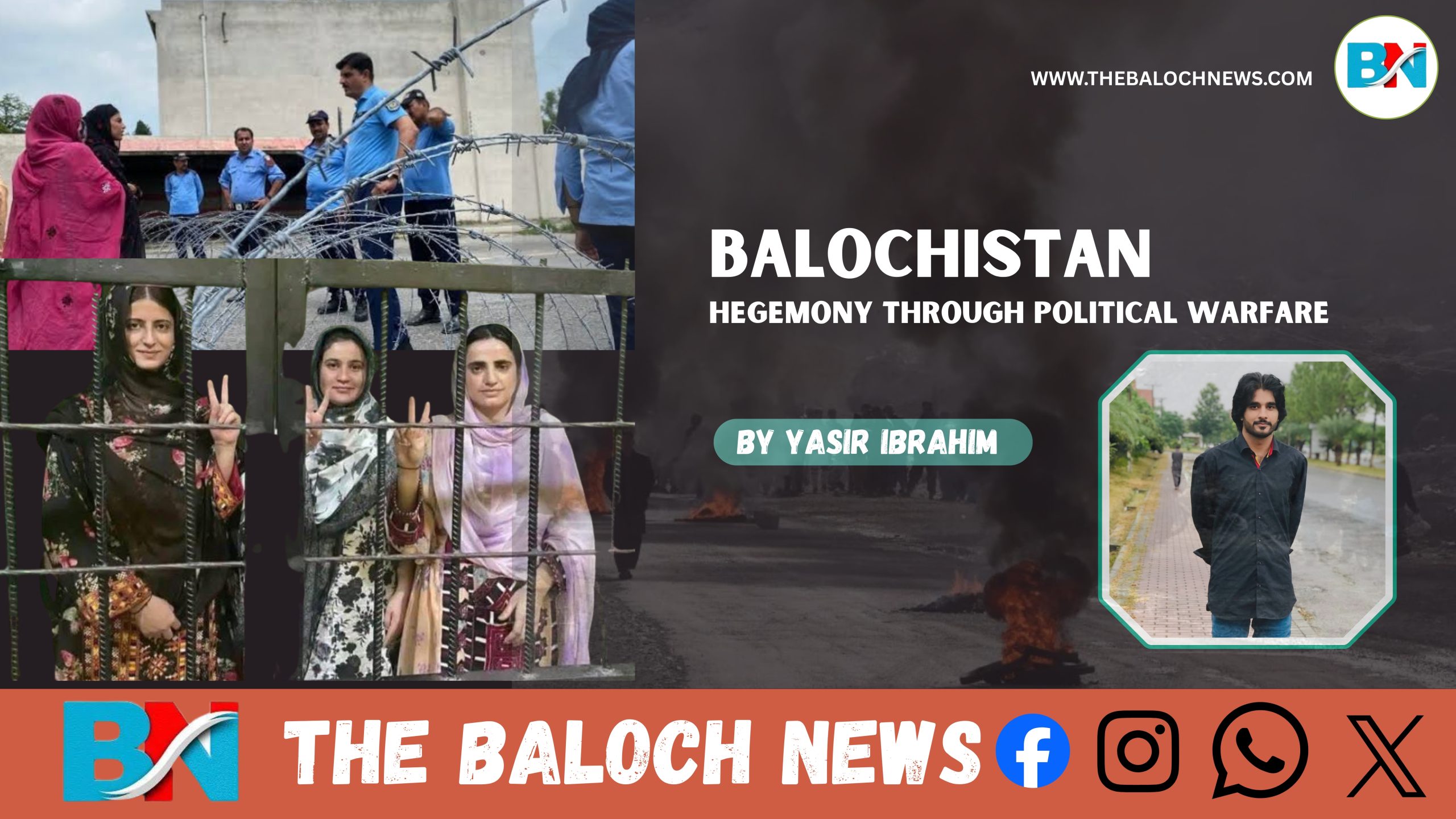
The current state approach towards Baloch leaders is a reflection of how it has employed the legal battles for its very interests. Under this, the state has masterfully succeeded with its solidification towards Baloch by implementing legal warfare and public manipulation as strategic tools to assert control. The use of law has two main purposes for the state: firstly, to give legal justification to security operations and policies; secondly, to limit the political space of Baloch nationalist groups, activists, and journalists. For instance, the key leadership of Baloch Yakjehti Committee (BYC), a peaceful political movement advocating against enforced disappearances in Balochistan, has been arrested under the ordinance—the Maintenance of Public Order (3-MPO)—with the guise of legality, which is undoubtedly a part of political warfare.
Likewise, placing the names of political activists in the Fourth Schedule of the Anti-Terrorism Act (ATA) can also be viewed as a form of political warfare. Several human rights organizations and activists claim that the Fourth Schedule has sometimes been used beyond its original purpose. They argue that political workers have been included in it without any strong evidence, which they see as a form of political warfare. Amnesty International, a human rights organization, strongly condemned the Anti-Terrorism Act, adding that the Act limits the efforts of those who advocate against human rights violations in Balochistan. What I now perceive is that the state has effectively learned how to counter Baloch activism by adopting the Baloch’s own strategy through a legal framework—a tool that was occasionally used by the BYC against the state’s unlawful actions.
The most important reasons behind the state’s use of lawfare are, first, to justify its actions at both the national and international levels, and second, to shift responsibility from security forces to legal institutions. By using legal tools, the state can claim it is acting within the law rather than repressing activism. At the same time, by shifting responsibility, the detention and monitoring of activists appear to be the work of the police, courts, and other legal bodies instead of the security forces. As a result, the state can suppress activism and control people while making its actions appear legal and fair. A clear example is the BYC and its leaders. Although the leadership of BYC has been arrested illegally, the state has, to some extent, been successful in imposing its narrative on people in other parts of the country and the world.
What happens as a result of this is that the use of lawfare is not only meant to punish leaders, but it also weakens the overall atmosphere of activism and undermines international trust in Balochistan. No doubt, when governments justify the actions they carry out as lawful, international organizations and countries might hesitate to condemn the activists. Furthermore, the Baloch may find it difficult to get attention, aid, and advocacy from foreign governments and human rights organizations. Consequently, it becomes harder for them to highlight their issues and achieve meaningful change without international attention and backing. For example, According to the Australian Department of Foreign Affairs, as of January 2024, Balochistan has experienced 2,752 enforced disappearances. International organizations have shown little to no interest in intervening, as Pakistan considers these actions legal. This ongoing cycle of state-justified repression leaves the Baloch isolated.
But when the Baloch learn how to spot false and misleading government stories, it becomes hard for the state to silence them. When they realize the very fact, they can speak up with confidence, correct misinformation, and show people in other parts of the globe what is really happening in Balochistan. As more people understand the truth, the state loses its power, and it would be difficult for the state to silence the Baloch. Political warfare is only controlled through counter political strategies. This is all of what we need
The writer studies Political Science at International Islamic University, Islamabad.
Facebook Comments