


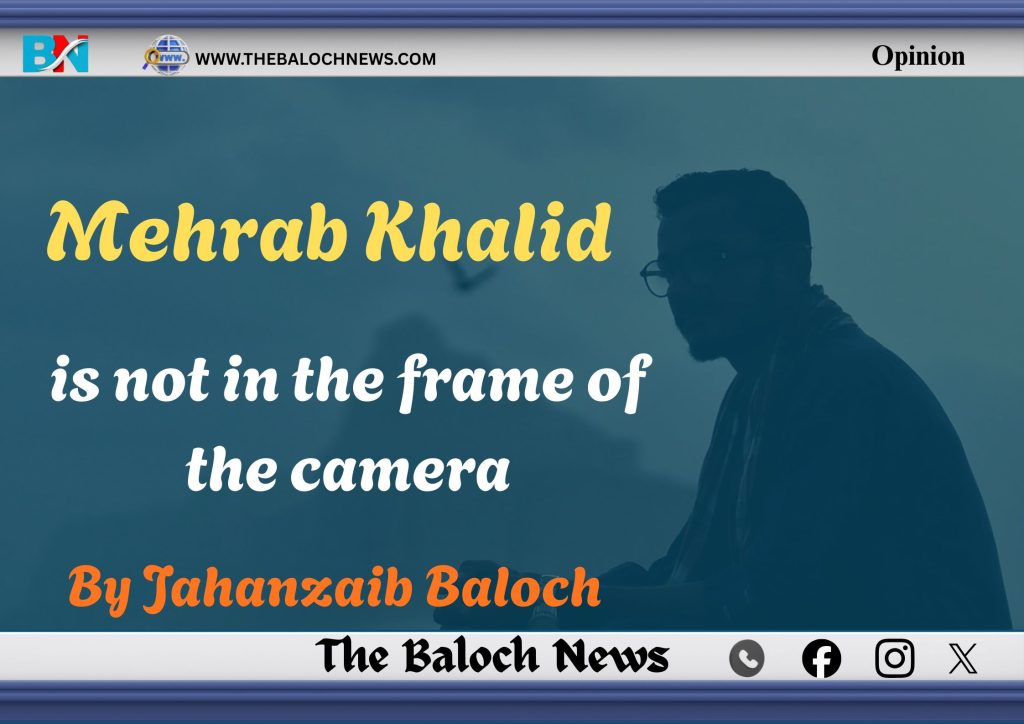
There are stories that filmmakers choose to tell, and then there are stories that choose the filmmakers. Today, one such story stands before us—a painful and unsettling story that has shaken the artistic community across Pakistan and beyond. It is the story of Mehrab Khalid, a young filmmaker whose camera once captured the realities of society, but who is now absent from the frame himself.
The people of Balochistan have long endured generations of political unrest, uncertainty, and conflict. For many families, the dream of education and a peaceful future often comes at a painful cost. Parents send their sons and daughters hundreds of miles away from home, carrying the burden of separation in the hope that distance may offer safety and opportunity.
Among those young dreamers was Mehrab Khalid, a 21-year-old student of the Film and Television Department at the National College of Arts (NCA), Lahore. Leaving his hometown of Turbat behind, he traveled to pursue his passion for cinema, storytelling, and visual arts. Like many aspiring artists, he sought to understand the world through creativity and expression. Yet today, the lens through which he viewed life has fallen silent.
For the past couple of days, Mehrab Khalid has been missing.
No official explanation has eased the fears of his loved ones. No clear answers have emerged. His absence has left behind a growing sense of confusion, anxiety, and helplessness. Every passing hour deepens the pain of those waiting for his news.
Mehrab was not merely a student. He was an artist in the truest sense—a storyteller dedicated to documenting the realities of his people. As the senior cameraman for Gedrioshia Point, a local digital news outlet, he covered significant social and humanitarian issues across Balochistan, particularly in Makuran. His work reflected a commitment to truth, culture, and human experience.
Through music videos, documentaries, and cinematic projects, Mehrab sought to bring overlooked stories into public view. He directed moving documentaries on Thalassemia, highlighting the struggles of patients and families affected by the disease. He worked as a Director of Photography on various films and played a vital role in shaping a new generation of Baloch cinema. His visual style was raw, organic, and deeply connected to the realities of the people he represented.
For a young artist, his achievements were remarkable. Yet what made him truly valuable was not only his talent, but also his belief that stories matter—that cameras can become instruments of empathy, awareness, and change.
Today, however, the camera that once documented the lives of others can no longer documents its own storyteller.
His disappearance has sent shockwaves through the artistic community. Students, filmmakers, writers, journalists, and creators increasingly find themselves asking difficult questions about safety, freedom of expression, and the future of creative work. If a young filmmaker dedicated to documenting society can disappear without explanation, what message does that send to others who seek to observe, question, and create?
Behind every public appeal lies a family enduring unimaginable sufferings.
Mehrab’s father is a heart patient. His mother waits each day with uncertainty and fear. His siblings remain trapped between hope and despair, searching for answers that never seem to arrive. Their lives have been suspended in an agonizing silence.
The disappearance of one individual is never merely a personal tragedy. It becomes a collective wound felt by everyone connected to them—their family, friends, colleagues, and community. In Mehrab’s case, it is also a loss felt by the artistic world, because every day he remains missing is another day that a promising creative voice is absent from the conversation.
Artists have always been witnesses to their times. They document joy and suffering, beauty and injustice, memory and identity. When an artist disappears, society loses more than a person; it loses a perspective, a vision, and a voice that contributes to its collective understanding.
Today, we appeal to people from all walks of life and to the global community of artists, filmmakers, writers, journalists, and creators. Raise your voice for Mehrab Khalid. Share his story. Demand answers. Refuse to let silence become acceptance.
Because silence is often the greatest danger.
Mehrab Khalid spent his young life behind the camera, helping others be seen and heard. Today, he is no longer in the frame of the camera. Until he returns safely to his family, friends, and community, that empty frame will remain a painful reminder that some stories are too important to ignore.
The camera is waiting.
The story is unfinished.
And Mehrab Khalid must come home.