


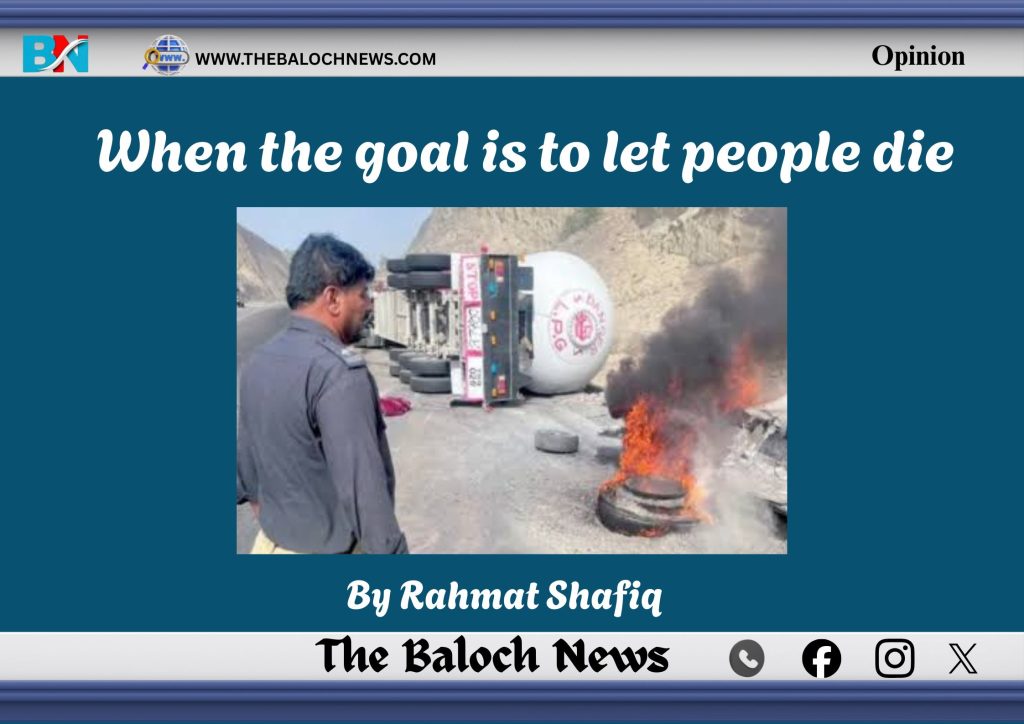
When people die, who to blame? Roads, authorities, administration, departments? And who to praise? Concerned authorities for carrying dead bodies; parliamentary politicians for addressing the issue; or praising God in case few survive with injuries? Among blaming and praising, people like us speak and write for a month until another accident occurs where we do the same: blame the roads, authorities, departments and praise God and a parliamentary politician for sending a helicopter.
In all these talks and words exchange, we try to sound more authentic, formal and relevant. However, in all these processes, we forget the flaws and vulnerabilities in Balochistan. My grammatically structured article will not help any Baloch until I am honest and saying the truth, even if it has flaws and is unstructured. As so-called structured and developed, Balochistan is transparent behind our eyes.
Accidents in Balochistan, which is perishing Baloch population, aligns with the concept of Biopower/Biopolitics brought by Michel Foucault. Michel Foucault reveals three main powers that involve Sovereign Power, Disciplinary Power and Biopower. Biopower, which refers to population control, is defined and interpreted in many ways; therefore, Achille Mbembe, in his essay, brings a distinction and extension to this concept called ‘Necropolitics’.
Achille Mbembe’s Necropolitics demonstrates contemporary forms of death-worlds and how it is decided whether someone should be protected or let to die. “The ultimate expression of sovereignty largely resides in the power and capacity to dictate who is able to live and who must die,” quoted in Necropolitics. We will not go into the depth of Necropolitics, but we will until we understand where Baloch lives lie. Whether installing roads and facilities reduces the risk of accidents in Balochistan? If yes, whom will it let live and whom will it let die?
Moreover, with all these current developments, narrated by the government, why is it still hard for Baloch to live on their land? Do indigenous Baloch really need infrastructure, institutions (which, on the other hand, exercise disciplinary power) and buildings over fundamental rights? If not, whose interests are fulfilled in the name of building roads and facilities for the safety of Baloch? Necropolitics is a broad concept as it originates from Biopower. There can be many interpretations based on this term. But Necropolitics in the context of letting people die or forming death-worlds fits for all accidents in Balochistan with no solution and representation.
Relying on this context, we can narrate that the population of Balochistan is on a state of being compromised. Actually it has been. Was it the first accident in Balochistan? Before that, we have seen many petroleum shops burn, Zamyaad accidents, Noshki tanker blast, Quetta road accidents, and many other that couldn’t come to the surface. On 28th Nov, 2018, a gas-cylinder blast in Turbat left more than ten students dead and over twenty injured. The solution from the administration was the restriction of gas-cylinders in shops. After a month, when everyone forgot the accident, there was no check and balance afterwards.
However, the decision from the authorities is scary and humorous simultaneously. Scary in one sense that Baloch are in wrong hands. Funny as the decision neither tried to solve the problem nor stop the next accidents. It is just like when there is an accident, one stops riding on roads. When I say it is funny, I mean what are they trying to do with their high experiences and decision-making. They must have scored much in competitive exams before reaching to this position and still fail to solve such problems. Or maybe they were not trained to solve the problems of citizens. Maybe they were to let those who bring money and let those die who seem nothing in the eyes of the power. Coming back to the topic, as the solutions from administration are only implemented after public outrage. And involvement of authorities on 28th Nov accident was due to the propagation of the news. Where there is no camera, where there is no one to speak after an accident, when the voice doesn’t reach to distant ears, no one will move their chair and talk for their interests.
The next concerning phenomenon is declaring it an act of God. In public discourses, we witness fatalistic and non-reachable authoritative roles. Let us put the recent accident in this concept. The bus actually carried passengers of Kech to Karachi and its end destination was to drop them back to their homes. The basis and fundamental question raises is that why they choose to go to Karachi. Was it their choice? Majority of people in Balochistan travel to other cities for treatment. And during the journey, they face more than two checkpoints where they are asked to show their identities. From here, we can understand that it is not an act of divine entity rather it is the compulsion of Baloch to travel on deadly paths and a systematic negligence. Moreover, the fatalistic belief restricts people to question and understand discourse on-play on the lives of people. Celebrating the survival of some must not stop why many burned, why many lost their lives, who tried to solve it, and who was silent.
All we can do is not to accept the norms associated with accidents in Balochistan. Next time, as it is usual, a certain accident occurs, instead of relying only on blaming and praising entities, we must embrace the hidden tactics that compromise the Baloch lives. These include necropolitics, solutions with no long-term durability, fatalism, celebration, and considering them natural. When we change the way we see how things are presented to us, we might not satisfy ourselves with false hope and construct to see the real wrong.