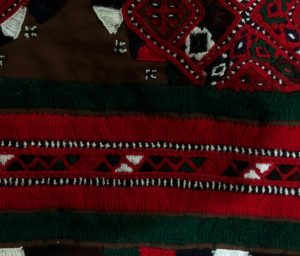
Balochistan belongs to the Mehrgadh Civilization – one of the earliest ancient civilizations – best known for its ancient culture, traditions, history, and tribes. Balochi clothes are among the most important elements of Balochistan’s history and culture. These embroideries historically link the motifs used in the dress making back to 7000 millennium B.C of Mehrgarh civilization. As Balochistan history was not documented in literature, the Balochi embroidery has been the biggest form of storytelling of the events and record. They identify regions, tribes, and environmental conditions. And these embroideries are locally termed as “DOCH.”
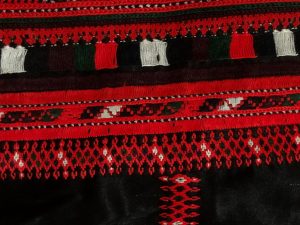

Balochi Doch (Embroidery):
Balochi embroidery is an ancient art form which is a geometric stitch shaping different designs. It is very complex and has a lot of details and depth. They reflect culture, tribes, and regions, and each region in Balochistan has different patterns of embroidery. This big detailed piece of work takes months, and sometimes years, to complete. These are named after people, places, herbs, animals, flowers, stars and historical incidents. However, the two basic styles of sewing are called Dochi and Pethi/Peeti. Dochis are completely worked on with threads. The sewers use 6 types of thread; dark green, red, brown, white, black, and dark blue. Meanwhile, Peeti is worked with threads, laces, and mirrors. Dochis are priced according to the clearance of work done by its Dochgir (A Dochgir is someone who sews the clothes) and the region.
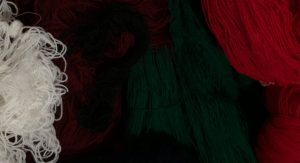

Theories on these six threads:
There are mainly two theories about the origin and usage of these 6 threads. The first one is that each one of these colors symbolises different themes; red symbolises blood, green fertility, blue symbolises the sky and the sea, brown symbolises land, black is for depth and shadows, and white for dignity. The second theory is that these are the basic colors. That is why, they are used with them so that we can create more colors.
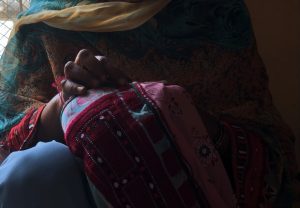

Structure of Balochi clothes:
Baloch clothes consist of three parts: Gushan/Sareeg (head scarf), Pashk (the dress) and Shalwar (the bottom). Embroidery on different parts of the fabric has different names and the different parts of fabric itself are called with different names. The chest area of the Pashk is called Jeeg and it is full of different embroidery patterns such as Pur, Toegge, Chakan, Seya o Ispeth, Chilako, Chenak o Tanab, Jalanguk, and Naal. And vertical lines around the pocket and each of them is called Patt (Patts are supposed to be Jalaar which is a kind of embroidery). Gool Patt is a horizontal line on the Daamon (hem). It is sewn around the Daamon and Thak. Thaks are clothes on both sides of the body which connect the Pashk. Pandol is the pocket which is also filled with the same complex embroidery and around the pocket is filled with Tekk. And sleeves are called Astoonk/Astheenk, and are also filled with the same kind of complex patterns. And the upper side of the sleeve is called Sar Astoonk.
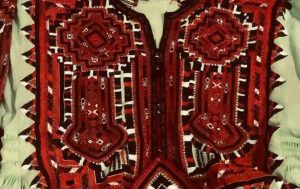

Difference in Doches:
There is a concept in Balochi clothes: Dodh and Bedodh. Dodh Shunz o Zard (Green and Red threads) Chilako, while Bedodh Shunz o Nasi (Green and Brown) Chilako. There is also another concept called Asli (Real) and Nakli (not real) Kanttofk. Asli Kanttok is pricier than the Nakli one because the real one is sewn in a more difficult manner and in difficult patterns. It has 4 stitches in a single form and the Nakli Kanttok has 3 stitches in a single one.
Different parts of Balochistan famous for their distinctive embroidery style:
Kowchik: It is a traditional embroidery style originally from Dera Bugti. Kowchik is deeply rooted in local tribal customs. Unlike traditional southern Balochistan style, the strict straight-line grids, the signature Kowchik style breaks away into highly organic, cursive leaf structures and circular medallion layouts. It is made with very vibrant threads and mirrors.
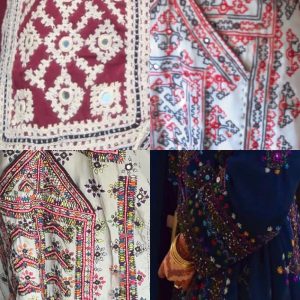

Jok: Sibi is famous for its unique design, premium features, and intense labor. Jokk is a solid filling stitch. It is dense and packed in result. It feels very smooth and firm. It is sewn with different variations of colors all together in a circular shape into a single motif pattern.
Momshaka: it is also called Musam-e-Kar, famous in Khuzdar and Kalat. It is a masterful cross-stitch and geometric filling technique. It uses exceptional details with fine threads to build highly structured, dense grids across the fabric. It is sewn with vibrant colors such as yellow, red, green, black/grey.
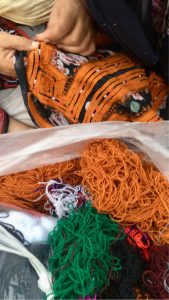

Balochi Doch is one of the most difficult, yet delicate forms of art. Each region has a distinct charm of its own Doch. Its various forms are also named differently in other parts of Balochistan. Even though it differs from each other by its name, pattern styles, yet these different forms resemble one thing – Balochistan.