


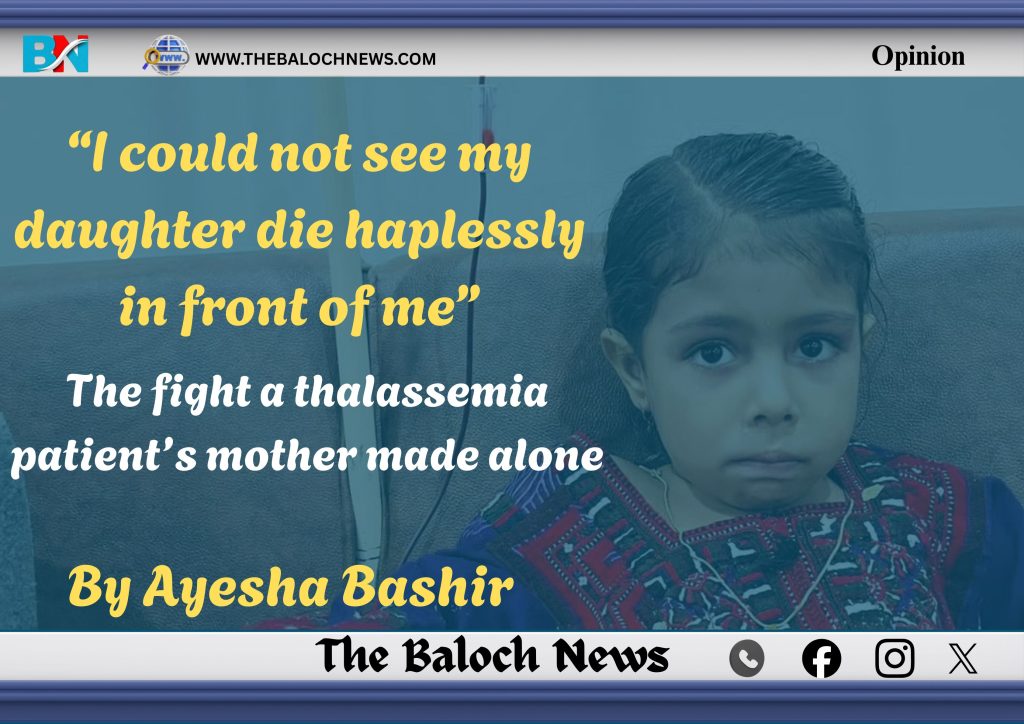
Mehtab Baloch, 8, with her blood group being A-positive (A+), hails from the Shahrak area of district Kech in Balochistan. She is a child thalassemia warrior – as referred to in the locality, attributing to the everyday fight thalassemia patients make bravely. Her soul speaks of her innocence, her silence tells a hidden story beyond it, and her smile teaches the lesson of hope. Born on June 23, 2019, after one and a half years of her birth, she suffered from diarrhea, due to which her condition worsened.
Time continued to move, but her conditions remained the very same. At midnight, almost at 2 O’clock, her parents took her to Turbat’s Civil Hospital for treatment. She was admitted there. After being given medicines and drips, she was brought back to her village – 45 kilometers away in the east of Turbat city. But after some days, her condition still showed no way to recover. Then she was taken to Karachi, where doctors told her parents that it was an issue of the stomach. There also, the doctors prescribed medicines, but of no benefit.
In the next session, they took her to Children’s Hospital in Karachi, where she was examined by Dr. Saqib. After countless tests, the doctor told her parents that she was diagnosed with thalassemia major and would require lifetime blood transfusions. Filled with traumas, they could not accept the doctor’s words. Her mother, Hina Aslam recalls, “My family and close relatives said that if once she was transfused blood, then her body would become dependent on it,” lost in thoughts, she continued, “therefore, we did not transfuse blood to her at the first time.” And they returned to Kech.
Time passed, and Mehtab’s conditions did not improve, but worsened. Amid the tensions of her child’s health, Mehtab’s father divorced her mother, excusing that he could not bear the expenses of a lifelong disease. “I could not let her get deep into the trauma of her disease in front of me, and as a mother, I had to do everything for her as possible as a responsibility, as a love of a mother, a parent,” she tells me with tears trickling down her eyes.
This was the moment a mother’s strength rose beyond her child. Despite various challenges and hopelessness, her devotion to her faith made her able to face them. “In the last seven years, I did not let myself fall because I knew if I had fallen, then my child would have fallen too which I never wanted.” And for her, Mehtab’s smile and her being alive were the only motivation giving her all the strength – that is what a mother’s love tastes like.
Hina shares that when her child showed no change in her health, they ignored people’s concerns and did the first transfusion in Turbat Civil Hospital in 2021. From that day, their struggling journey ignited – from looking for blood donor to successful blood transfusion. They travelled to Turbat from their village through rented cars three days before each transfusion. They would firstly beg their relatives and other acquaintances for blood, sometimes succeeding and other times not. In case of receiving blood, they would sometimes face transfusion concerns, when the civil hospital staff excused, adding, “After some years, they will die, so why do you people struggle for these children?”
The supra sentence was the most painful sentence Hina had to hear, considering her being a single parent to support her struggling-in-pain child. “Not only theirs, but no one could give the guarantee of anyone’s life,” she told me with almost torn eyes. “A mother could never give up on her child no matter how the situations are.” And she, as a mother, was fighting everything and everyone to save her child with her heart out. “If one cannot support me and my child, they have no right to take back our hope from us.” And she is very much right to her point.
Like every other child, Mehtab also wanted to join school, but her disease did not favor her being admitted to a school. But despite that, her mother admitted her to school but that could not run long because each blood transfusion would take back her energy from her. “I cannot bear the hot weather like the other normal children,” says Mehtab, looking down when I asked her of her school. “My feet and body pain and I become unable to walk even. Neither I can pay attention nor can I bear the weight.” She remained silent for a couple of minutes and then looked deep into my eyes and added, “My heart wishes to play and study, but I cannot, because the disease brought in me an exhaustion with which I cannot fight very hard.”
Hina sheds tears in silence, but would deal very bravely in front of her to become her only strength. While recalling financial challenges, she adds, “It would take me almost thirty thousands per month for transfusing blood and basic medicines, while the whole treatment was unaffordable for me,” she says, but hopeful that with her continuous efforts, she could someday afford what could save her child from death.
When they went for monthly checkups in Karachi, the expenses were almost Rs. 70,000 per month, which they could not afford. So, they would complete only a short checkup with doctors, would not transfuse blood, and came back the same night because they could not afford to stay there either. There, one bag of blood costs Rs. 5,000 to Rs. 8,000, which they could not afford. Therefore, they thought to do the transfusion in Turbat, which was extremely challenging though but affordable. As time passed, the journey became tougher because most of the time, she could not complete the expenses, and the treatment was missed.
To her fortune, the young lads in Turbat city, with their self-support followed by public support, initiated a campaign to safeguard the thalassemia patients in Kech in any way possible, named Kech Thalassemia Care Center (KTCC). Before it, Mehtab’s family, particularly her mother, carried the weight of financial and emotional pain at every transfusion. Most of the time, when they went for transfusion, the staff at Civil Hospital would ignore them. They did not check the CBC properly, nor did they screen the blood. They would transfuse it directly into her body. It would take a complete day, yet the blood transfusion would not complete.
Then came 2022. The day when Mehtab was registered at KTCC, the burdens began to lift. From that day until today, they are free from all financial and emotional burdens. Financially, in those 3 years when they went to Karachi, it took approximately Rs. 210,000 (two lacs and ten thousands rupees), which was tough to manage for her mother. But after being registered at KTCC, the center has almost taken the burden on itself, due to which they now feel completely light and more satisfied with the care the center provides. “It (KTCC) makes us feel home,” she says.
Hina shares that when KTCC was not established, they had lost all the hope. They would ask themselves, “How will our children be? How will their futures be?” But Irshad Arif, founder of KTCC, has shown a light in darkness. He, along with his team, made them believe that their children would be fine and they would spend a life like other normal children.
She further shares, “I just come on the blood transfusion day, transfuse the blood, and on the exact day, my child is given blood timely with full care. I don’t know from where they bring us blood, but we mothers have no tension. We just come, transfuse the blood, and go back.” Her gratitude has no limit. She shares, “One cannot imagine how grateful I am to Irshad Arif and his team for their unwavering support towards us and we pray for them.” While thanking the team for everything and feeling ease from financial burdens and other concerns, she says, “The way they support us and care for us is indescribable in words. The medicines which cost almost Rs. 10,000 are given to us free of cost here every time we come.”
The KTCC team visits every village and area in Kech district particularly to organize blood donation camps and bring the same in the center for the registered patients of thalassemia who are now nearly 500. They do it for free and the whole people in the locality support them with everything they can. “Had it not been KTCC, I do not know where our children’s lives were supposed to destine to,” Hina says, with her heart full of prayers for the KTCC team.
KTCC staff never let them feel that their children are victims of such a disease. They take care of them and never let them face any hardship or circumstances. Because of this, KTCC is not only a center for her and her child; rather, it is like a home. “Here the children are never termed as patients, but warriors,” says Irshad Arif. “Because the fight they (children) are making is not less than a warrior-like-stuff. They are our heroes who are silently struggling the hardest battle of life.”
Believing the disease to be very brutal, Hina sadly says, “This disease is like a snake’s bite whose wound can never be healed. It does not let you stuck into being alive nor dead, but continues to break you inside every day.” Going through all the experiences, she made an appeal to the public at large, “Before marriage, just do the HB electrophoresis test so that your upcoming generation should be free of this challenging disease of thalassemia.”
Coming to her child Mehtab, Hina concludes, “No matter how challenging things turn out to be, I will keep fighting for my child – against anyone and anything.”