


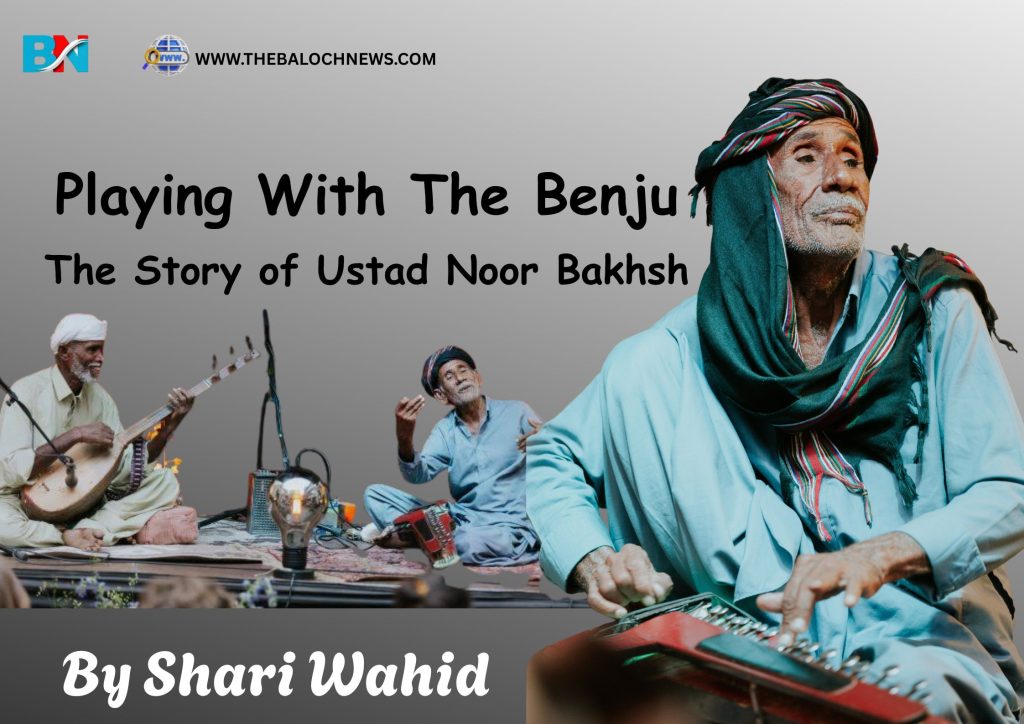
Benju is more than a musical instrument. It is a living thread that stretches across time, carrying the voices of those who came before, whispering stories that cannot be told in words alone. Its strings shimmer and hum, sometimes bright and playful, sometimes low and haunting, moving with the rhythm of life itself. Born from ancient traditions and carried across oceans, the Benju has woven itself into countless musical landscapes: from folk gatherings in quiet villages to the intricate compositions of classical music, from intimate storytelling to grand stages where its voice reaches far and wide. Every pluck, every strum, is a heartbeat, a bridge between the past and the present, between memory and imagination.
The sound of a Benju is both grounded and wandering, familiar yet surprising, capable of stirring laughter, reflection, and longing all at once. It holds the weight of culture, the freedom of expression, and the joy of creativity – a small instrument with a power far greater than its size. In its resonance, one can feel the pulse of history, the connection of people across generations, and the quiet magic that happens when music becomes more than sound; it becomes life itself.
The Benju, known in Balochistan as a form of classic to the modern music, carries a history far more global than its deeply rooted place in Balochi music suggests. Its origins lies in Japan, where a small, key-operated string instrument called the Taishōgoto was created in the early 1900s; traders and travelers eventually brought it to South Asia, where it found its way into the hands of Baloch musicians. What began as a simple imported toy-like instrument was quickly transformed through local creativity: Balochi artisans lengthened its wooden body, added multiple melody strings and sympathetic strings, expanded its range, and reshaped its tonal character until it became something entirely new – an instrument capable of expressing the emotional depth, longing, and rhythm that define Balochi folk music.
Over the decades, the Benju became a defining sound in Baloch culture, particularly in genres like zahirók, where its bright yet haunting resonance enhances themes of separation, memory, and love. Pioneering musicians such as Ustad Gul Mohammad in Karachi’s Baloch community helped refine the modern form of the Benju, while others like Abd-ur-Rahmân Surizehi carried it beyond Pakistan, showcasing its expressive potential on international stages. In recent years, artists like Ustad Noor Bakhsh from Pasni have revived its popularity by electrifying the instrument and introducing it to global audiences, proving that it, though foreign in origin, has become an inseparable part of Balochistan’s musical identity; a perfect example of how a culture can reshape something from elsewhere into a symbol of its own voice and heritage.
After arriving in Europe, Ustad Noor Bakhsh experienced something he had never seen before: crowds who did not understand his language, yet felt every note as if it belonged to them. Audiences listened in complete stillness when he played his slow, meditative pieces—eyes closed, breathing in rhythm with the rise and fall of his Benju. And when he shifted into faster, trance-like melodies, people stood up from their seats, swaying, clapping, even crying, overwhelmed by the emotional power carried through his strings. Many described his music as “spiritual,” “healing,” and “hypnotic,” and some said they felt as if they were traveling through deserts, mountains, and oceans without ever leaving the room.
His simple presence, a shepherd from Pasni with a hand-built electric Benju, became a symbol of how pure, heartfelt music needs no translation. Everywhere he performed, from small halls to major festivals, people lined up afterwards just to thank him, hold his hands, and tell him that his music had touched something deep inside them. This response from listeners around the world showed that Ustad Noor Bakhsh was not just sharing Balochi music; he was sharing a feeling powerful enough to cross borders, languages, and cultures.
Ustad Noor Bakhsh’s life reads like a living legend: born into a nomadic shepherd family along the rugged Makoran coast of Balochistan, he spent his early years herding goats and cattle with his father, moving across windswept lands and salty shores. As a child, he listened intently to his father playing the Suroz under open skies, while the call of birds and the rhythm of the sea became his first teachers. At around the age of 12, he first heard the Benju being played by Ustad Khuda Bakhsh during a village gathering and was immediately mesmerized. He abandoned his herd to follow the master’s music, and soon after, was formally his student, tying the sacred thread that binds teacher to disciple. By the time he was a teenager, he was already performing at 14, he accompanied singer Sabzal Sami, and at 15, he became Sami’s long-term Benju accompanist, a partnership that lasted over 40 years.
Throughout the decades, Noor Bakhsh’s life was shaped by hardships: personal tragedies including the loss of his first wife and the drowning of two of his sons, both of whom harbored a passion for music. Despite this, his love for the Benju never wavered. He developed a deeply personal, meditative style, blending Balochi folk melodies with the improvisational complexity of South Asian ragas and the emotional ornamentation of Persian and Kurdish traditions.
What makes his journey even more remarkable is how he adapted to his surroundings: living in a remote village near Pasni, he set up his electric Benju using a single-coil pickup and a small Phillips amp powered by a car battery (and sometimes solar power), because electricity was scarce. His performances, once confined to weddings, healing ceremonies, and local gatherings, caught wider attention only in his later years, when recordings made by anthropologist Daniyal Ahmed went viral.
In 2022, he released his debut album “Jingul”, recorded live at sunset near his village, featuring mournful Balochi poetry, shepherd’s tunes, and improvisations inspired by bird calls. Since then, he has toured internationally (in Europe and beyond), bringing his deeply spiritual, trance-like Benju playing to new audiences and cementing his reputation as a bridge between Baloch folk tradition and the wider world.
The overwhelming response to Ustad Noor Bakhsh’s performances in Europe highlighted the universal power of his music. Through the Benju, he not only represented Baloch culture but also demonstrated that authentic, heartfelt expression transcends language and geography. His melodies connected people from diverse backgrounds, proving that tradition, dedication, and emotions can create a bridge between worlds. And in every performance, the sight of a humble shepherd from Pasni, playing a hand-built electric Benju under the glow of foreign lights, reminded audiences that sometimes the most extraordinary journeys begin with the simplest of beginnings.