


English Translation: Nabeel Armaan
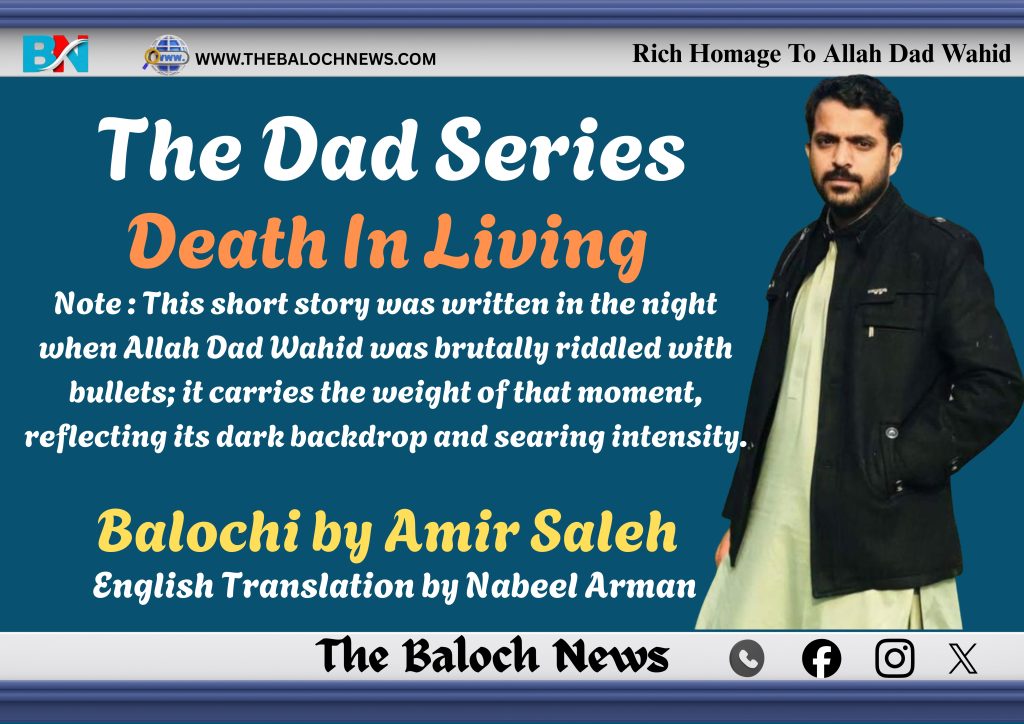
Note : This short story was written in the night when Allah Dad Wahid was brutally riddled with bullets; it carries the weight of that moment, reflecting its dark backdrop and searing intensity.
Jangiyan, the author of Unsaid Story and A Dead Body Embraced by Dreams, lived in a remote village. On the night of 7 December, 2019, he saw a dream in which Balochistan was fighting for its life—a war that had continued for decades.
In the dream, his fear awakened and spoke to him: “I must not die with bullets.”
This wandering fear unsettled him deeply. He told himself that if he woke up, he would not allow fear around him for a while. Among all the kinds of death, Jangiyan feared only one—the death with bullets.
That night, a cold breeze blew outside. Jangiyan suddenly awoke and looked around his room. Beside him laid an unpublished manuscript on the life and art of Mubarak Qazi.
Jangiyan was thirty-five years old. Like many literary figures, he remained constantly absorbed in literature. He admired the writings of others, but whenever he read his own work, it dragged him into restless, frenzied thought. He had translated the book Stories of Spilled Blood, yet remained uncertain whether it should ever be published.
He was aware of literary debates and discussions, but he never participated in what he considered shallow arguments. Today, his eyes were yearning for rest. He feared no death—not hanging, not accidents— but only bullets. The thought that someone might suddenly appear and shoot him silenced him, and he would die with bullets. This same growing fear had silenced him. His silence was like the sea: calm on the surface, carrying storms within.
Jangiyan thought that writing stories soothes the heart and illuminates the soul. Literature was his refuge, his way of searching for the self. He wrote continuously, capturing those elements essential to every land and every nation.
A year later, he finally sat down to write the dream—the dream of his death with bullets. What if this story turns into a reality? He wondered. The dream had disturbed him all the year. No matter the cost, he felt compelled to write it. Jangiyan was the editor of the annual literary prose magazine Zindmàn, and he planned to publish the story fictionally in its seventh edition.
He picked up his pen and began:
“On 21 December, 2020, at 8:30 in the evening, exhausted from lack of sleep, I left my room and went to my friend Gulab’s house in search of peace and rest.
Gulab is a graduate in Economics from a prestigious university—a well-read man. Whenever restlessness overtakes me, I seek his company. That night, we sat beside a bonfire, talking about comfort and peace. At 8:30, two men dressed in black arrived on a motorcycle. I remained silent, but Gulab scolded them, and they left. I was shivering with cold. They watched me, whispering to each other, and offered me a cigarette. I rarely smoke, but at that moment, even if I had never touched one before, I would have accepted it. They kept checking their watches. The fire began to fade, while my fear intensified. One nodded after looking at the time—it was 7 O’Clock on 21 December. Three minutes later, the man with red eyes fired two bullets into my head and three into my chest. I fell beside the fire.
I was dead—yet aware. Blood soaked the sand. I heard the motorcycle fade into the distance. Smoke choked me; I did not want to sleep, but it forced me into darkness.
Jangiyan stopped writing. His body was drenched in sweat. He lit a cigarette and stepped outside, thinking: dreams are gifts from God. They do not always become reality, yet they fuel creativity. Dreams are moments of absolute freedom—where existence is felt most deeply. He returned, put down the pages, and prepared to sleep.
That same night, four armed men entered his room and woke him up. He asked to change his clothes. They allowed it.
“Tie your hands and come with us,” they said.
They took him to a deserted place. Without a single word, they fired seven bullets into his body. His smiling face collapsed onto the blood-soaked earth. The men left before the blood stopped flowing.
It felt like there had been rain and he was wet on that land. Blood was spilling from his body, and the thirsty land’s colour was changing.
Three months later, the annual magazine Zindmàn was published. On the first page, in bold letters, it read:
“The editor of this magazine, Jangiyan, was martyred on the night of 21 December.”
I searched through every page of the magazine.
The dream he had written was nowhere to be found.