


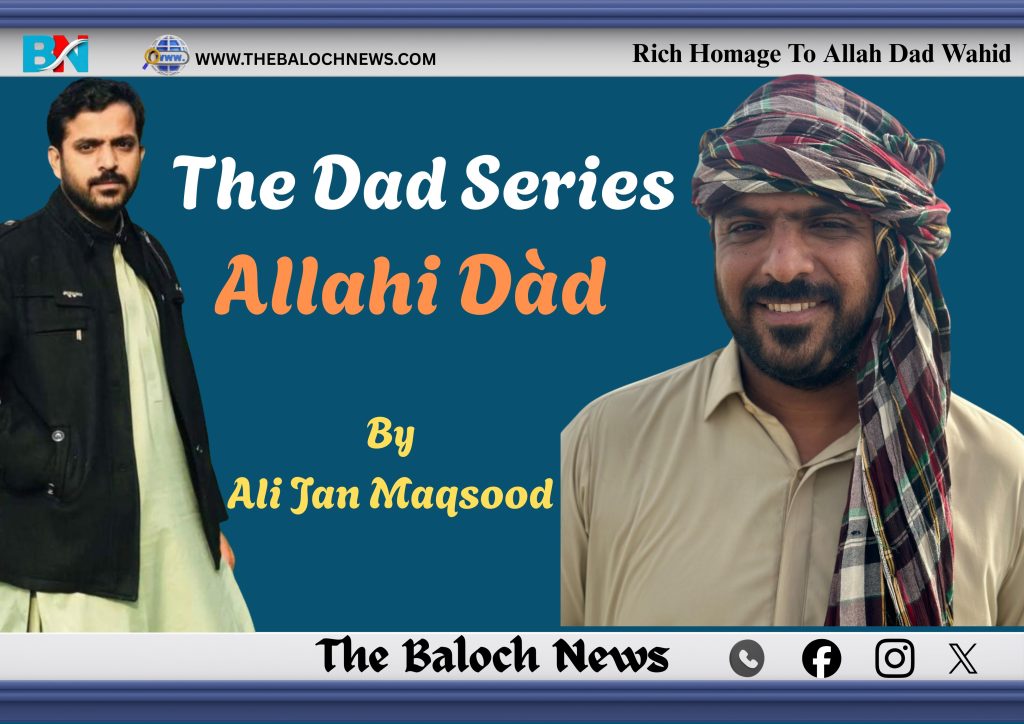
That day, he was very happy. Smiling. Laughing. Joking. Working in the marriage ceremony [of his niece] and making us all work delightfully. Sometimes on the roof of one home, and other times the other for binding the tents. Boosting everyone of us to work well because it was a marriage and “people should not complain of mismanagement”. I had rarely seen him this much happy.
To be fairly honest, I did thought of this at the very moment: “Dàd, may you be the same happy all your life.” Unbeknownst of the very awful and never-forgetting moment of his [physical] departure jus moments later, I was praying for his long and happy life. Moments later, I was sitting right there… in front of his lifeless body and wandering: “How come we bridge the gap of your [physical] departure, Dàd?” It was hurting and the same thing was haunting me inside: beside losing a family asset, we had lost a national asset too.
Although short, he lived an inspirational life. Despite being very near, we never knew what he was doing and for whom (but what he was doing was, once and all, for the national development – and definitely for the sake of Balochi language and literature). All we knew was: every morning he woke up, started music (quite aloud), opening his laptop and a book beside him. Working. Reading. Writing. When a little tired, he would close all the opened stuff, make a warm walk across the society, meet and greet everyone in the society (and sometimes went out with friends), have a mind-fresh and get back to his work – the work we rarely knew what, but long-lasting.
From early childhood till his last, he was a straightforward being. Someone who would say whatsoever would come in his mind. Perhaps that was the reason he had a very clean heart. Even in times, my mother used to mind several of his words, but she misses every single piece of his word until now. I never knew, but deep down, she now loves the name and adores it to the extent of even asking Dad’s mother for “taking Allah Dad’s name” for one of her grandchildren just because she realizes how a family asset he was.
To be literally fair, I had never seen my mother crying and going mad that much as I saw her that night and the following day. Not even when my father had died did she cry to this extent. That is the Allah Dad we have lost [physically] – the one who had touched every heart and soul in the society, among his friends and, though after his re-life, inside every Baloch heart and soul.
He bothered less and did his work himself. At times, when I was on bike and way home and saw him going somewhere outside, I would offer him lift, but he would refuse, saying he would go very near and make a walk. Even in his very last [physical] day, he did all the work himself including arranging the tents, bringing the stuff from Anjuman and preparing all the other stuff which we later used on his own re-life instead of the marriage – perhaps he did not want bother any one of us even after his re-life.
He was very caring for all of us. Three days before his re-life, he came home and asked me to come in his room (he had built which still is not fully complete). Advising me to take care in many things, he also asked for writing in Balochi language while suggesting some translations of law-related books. “I would do the proofreading and take every burden of its publication. Just give me the rough copy of the translation in Balochi once,” his words would always push me what I missed back then.
He had built a room out of his own income which he received through his part-time job. Not for his well-settled life but for us all. One day, he called me in his room and saying, “Now the room is ready. We will not be bothered if guests come. If your friends come or mine, we will make them stay here. I will make it a ‘Baitek’ and open a new gate from the left touching the main gate. Now don’t think twice if a guest or a friend comes.” We still call that room “Dàde kamrà”.
To be very honest, I do not call it “Dàde Kamrà” when his mother is sitting. Though she has been very brave since the day of the incident, but it still hurts her each time Dàd’s name comes. Though she never asked me, but deep down, she wants to question: “What wrong did Dàd do that they killed him?” Once I heard her speaking, “They do not need a reason to kill a Baloch,” she found an answer herself for her never-questioned quest for Dàd’s re-life.
When Dàd came back from Islamabad due to threats and other issues, he found it an opportunity to give more time to his research work and establishing his own publication – the Dodman Publications. For the very purpose, he visited Balgatar where, he said, he met an old man who would look into the bone and make predictions. Dad found it something historical and wanted to bring it on the record. He went there himself and did all the work which, he told, was to be published in the one of the articles in the coming “Ràjmàn Series”.
There are so many tears which are yet to be recorded in the written form: the tears shed on Dad’s re-life, during the days of his funeral, the family lectures I received after his departure and, above all, contributing to the cause he left behind. Only if life supports.
“So, now tell. Are you a journalist, a lawyer, or a political worker?”
I wish I were one, Dad. Truly.