


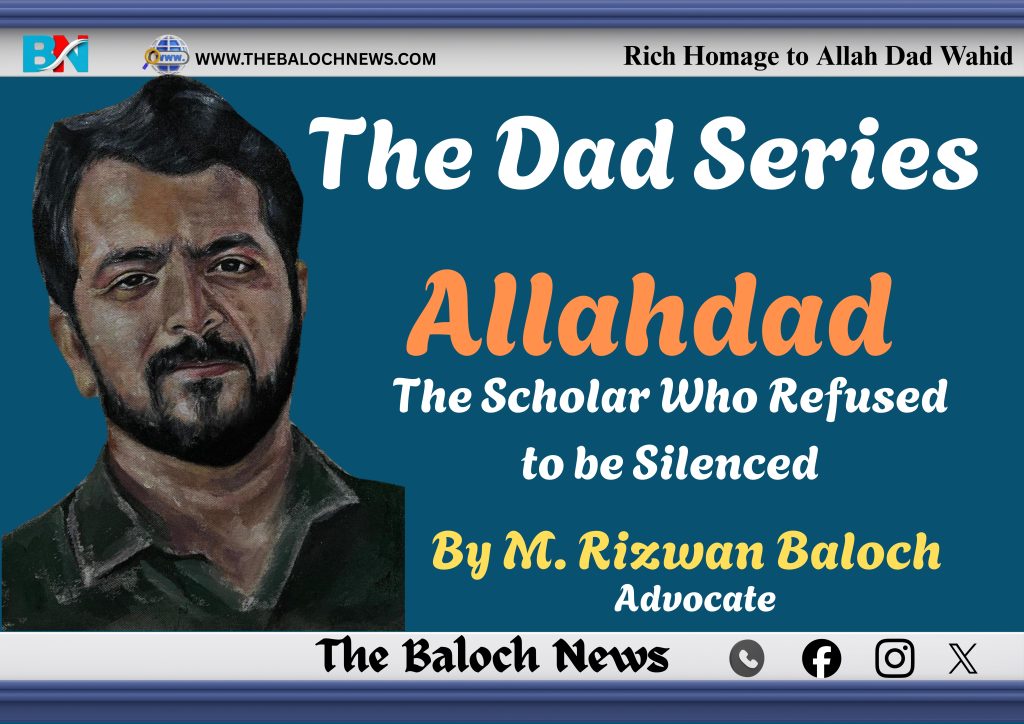
The Dad Series
Allahdad, a brother and friend (he always emphasized that his name is written as a single word — Allahdad, not “Allah Dad,” as it is often misinterpreted), was killed by a military intelligence–backed so-called death squad while sitting at Gamshad Hotel. His killing was not only the loss of one life, but an attack on education, language, and intellectual resistance. This is not the first time that prominent thinkers and activists, including Prof. Saba, Arif Barakzai, and other intellectuals, have been targeted for their work. Such acts reflect a broader pattern aimed at silencing voices that promote knowledge, critical thinking, and social awareness.
I received the news while I was at work. At first, I could not believe it. Moments later, my younger brother sent me photographs. Tears filled my eyes. I was far away and helpless. One question kept repeating in my mind: Why Allahdad? He was not affiliated with any political party. Yet he was targeted because of his work for the Balochi language, education, and public awareness. Following repeated threats and calls from Military Intelligence, he was pressured to work for them, but he firmly refused. I also believe — though I cannot confirm with certainty — that he may have been pressured to abandon his work for Balochi causes, as such tactics against Baloch intellectuals are common. After this period of harassment, he left his MPhil studies and returned to Turbat. Although his friends advised him to leave the country for safety, he chose to remain among his people. This decision ultimately cost him his life, but it revealed the strength of his character — principled, brave, and selfless.
He was an active member of Nokaap Labzanki Majlis in Karachi, where despite his young age, his sharp intellect and maturity set him apart. He worked tirelessly to educate and motivate other members, promoting reading, writing, and translation. He regularly guided his colleagues and young writers by proofreading their translations, reviewing articles, suggesting works to translate, and mentoring them to improve their skills. Allahdad was also committed to academic writing; he always cited sources carefully and once told me that his purpose was not to write a book, but to introduce important works to readers and encourage translations. Even with heavy workloads and multiple responsibilities, he remained committed to strengthening Balochi literature, improving writing standards, and building a culture of serious reading and intellectual work.
I personally experienced his encouragement. I had never seriously attempted to translate into Balochi and often hesitated. One day, he gave me an article by Dr. Mubarak Ali titled “Qanoon Ki Baladasti” (Rule of Law) and asked me to translate it. Although I had never written in Balochi before, I tried. He carefully proofread my work, corrected my mistakes, and motivated me by saying, “You already have the ability — you only need to put in extra effort for your language.” His criticism was sharp in wording but empowering in purpose. He made people believe in their potential and proved that growth comes through discipline and commitment.
During his time at the University of Karachi, he stayed at our home while I was completing my law degree. He encouraged me to read extensively, especially logic, critical thinking, and history. Once, I questioned the relevance of history, and he replied:
“How can you stand in court without understanding history? The court system depends on references — for clients, justice, and legal reasoning. History shows us how laws developed, the logic behind each change, and the principles that shape legal systems. By studying it, you learn to think critically, connect ideas, and approach cases with clarity. This knowledge will guide you throughout your legal career.” His words reshaped my understanding of law. His criticism was always constructive, not personal.
Allahdad had a deep attachment to Balochi literature and linguistics. Whenever we were free on Sundays, we would go together to the Saddar Sunday Market in Karachi to search for books. He believed that knowledge should not remain limited to elites but must reach ordinary people in their own language. Even after I left the country, we stayed in contact. He never complained about exhaustion, and he continuously spoke about building a culture of strong writing, research, and intellectual work in Baloch society.
Allahdad began reform at the household level and extended it to society and the nation. His mission was education, literacy, and awareness.
He contributed his time, expertise, and services not only to the Rajman Research Book Series and as the founder of Doodman Publication, but also to several other literary platforms and independent writers. Beyond formal institutions, he generously supported individuals by editing manuscripts, proofreading translations, reviewing articles, and providing guidance.
Tragically, his untimely death is not only a loss for literature and education but also a stark reminder that the state is involved in suppressing and eliminating the intellectuals of the Baloch nation.
To those who believe bullets can silence ideas, the message is clear: individuals can be killed, but consciousness cannot. Allahdad may no longer be physically present, but his struggle continues in every student, reader, and thinker he inspired.
تو پہ سرانی گڈگءَ زندءِ ھیالاناں کُشے
پہ سِندگءَ داشت کنے پلاں چہ بو تالانی ءَ
عطا شاد