


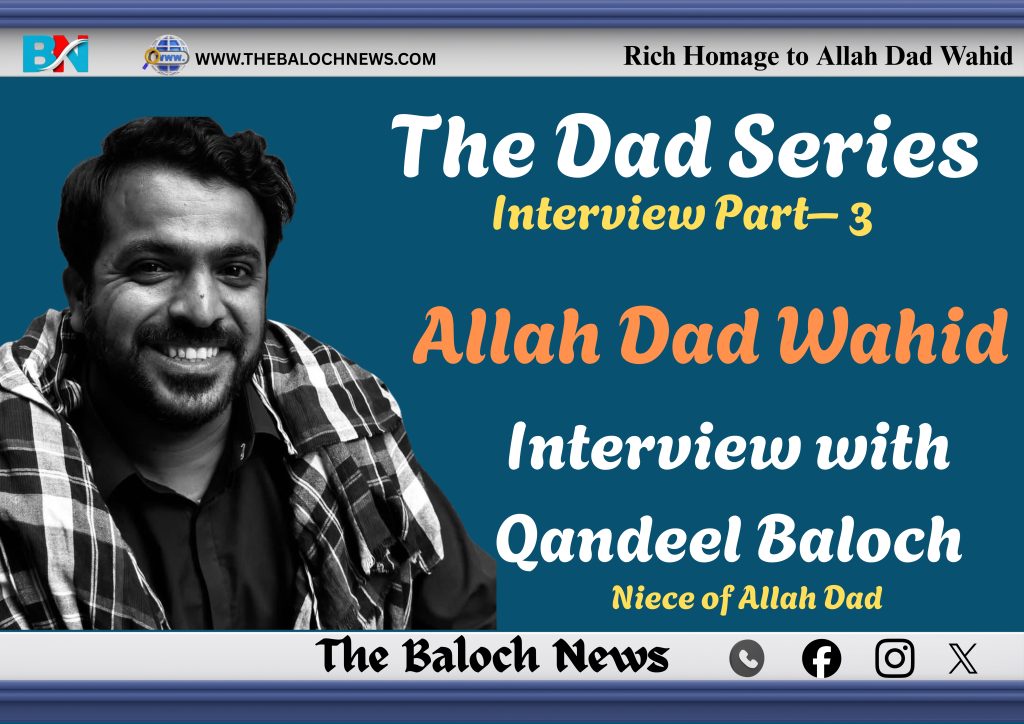
Qandeel Baloch is the niece of Allah Dad Wahid. This interview marks the third interview of our ongoing tributary series to the departed scholar, Allah Dad Wahid, under “The Dad Series”.
Question: How has his absence influenced your life?
Qandeel Baloch: After losing him, I realized a void I had never felt while he was alive. He was an intellectual father to me. From my early schooling until now, he remained deeply concerned about my learning. I believe he saw in me what I could not see in myself.
He encouraged me to read far beyond the school syllabus, to explore non-fiction, and to see the world through books. I still remember how, in fifth grade, he handed me a book by Dr. Mubarak Ali while my classmates were only focused on their textbooks. Under his guidance, I was unknowingly building a habit that I am grateful for now.
I remember, he would personally bring me books and blank pages asking me to read and then write whatever I understood from them. At that age, it sometimes felt exhausting, and I would look for ways to skip it. Only later, I understood why he would ask me for this. He was the one person I trusted with everything. I would read, note down my questions, and message him. Sometimes he would answer, and other times he would push me to search for the answers myself.
After losing him to a bullet, I feel intellectually orphaned. That night, sitting beside his corpse, I realized I no longer have that guiding presence; I had lost him all at once and for life.Yet, at the same time, I feel he gave me enough to carry forward; enough wisdom to choose my books carefully, to think deeply, and to contribute meaningfully in my own way.
Question: How do you see Dad as a family man?
Qandeel Baloch: Dad was never expressive with his emotions, but as a family man, he was someone we would trust with anything and depend on. His love would come in quite practical ways. He understood his responsibilities and when he was trusted with any work, he would complete that anyways, putting in his all efforts. I would see him selfless; he preferred others’ needs over his own.
As we grew older, we would mainly remain out of the city for his studies but remain connected. He, too, was out of the town for his studies. Each time he was to come home, a day or two before coming, he would call and ask individually if we needed anything. And lucky of me, I would receive a text later if I needed a book or stationary.
Dad had a very calm nature and did not speak much, like wise people usually do. But he was exclusively rational and straightforward even if the truth hurt. This sometimes made us think before asking him for something but he would say, “Man insàne an; nawara’n”, and then hesitation would leave.
In tough times, Dad would never turn his face. Noor Pak forbids bad times, but they came; he would stand firm for us without any second thought. I am so humbled by how giving his nature was.
Aaah! Devastation of losing such a figure in the family to bullet and no one to be held accountable for his blood.
Question : Anything else do you want to add?
Qandeel Baloch: Dad did not seek a name for himself while he was alive, but those close to him knew how selflessly devoted he was. His demise has deeply affected our family, but now I understand that Dad was not only ours. He belonged to the people. He belonged to Balochi. He belonged to a cause. His death revealed many things that even we, as a family, did not fully know during his lifetime.
Beyond his contributions, Dad had a beautiful personality. He was welcoming and inclusive. His intellect never made him feel superior. One could see him sitting in a literary gathering, and the same person would interact just as warmly and equally with ordinary people. That was how down-to-earth his nature was.
Not only at the level of academics or cause, but as a family, we feel his absence in haunting ways. It is painful to see his friends and deeply miss seeing his face among them. Sometimes, overwhelmed by grief, Noori Maát (Dad’s mother) looks at his books and asks, “Ey ketabà chè màn ky Dàde eshàne pushta jath?” (“What do these books hold that they killed him for them?”)
I remain answer-less. I do not know how to tell her that they fear books and minds like Dad’s more than they fear weapons. Dad is our greatest present. He is still among us — in the books and literature he brought forward, in the dreams he saw, in the bonds he built, and in the cause he served. As long as these live, Dad will live on.