


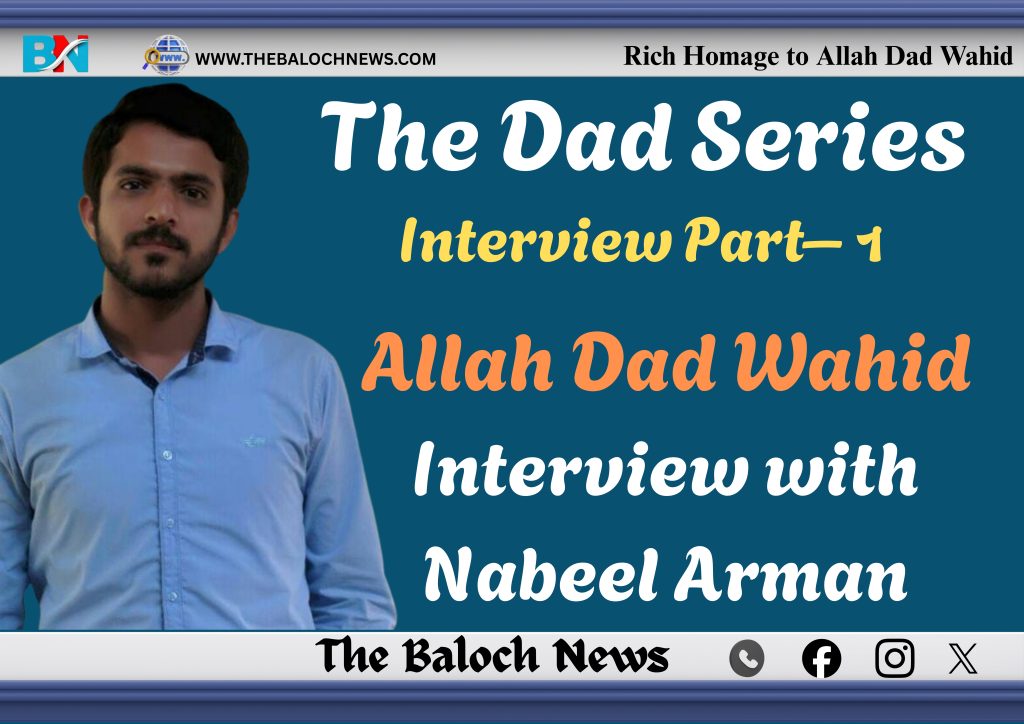
The Dad Series
This interview is the part of the series of interviews we, at The Baloch News, are taking from the friends and family members of Allah Dad Wahid under our ongoing series “The Dad Series”. Our first interaction was with Nabeel Arman, a friend of Allah Dad Wahid.
Question: How do you know Dad? Can you recall moments of interactions with Dad?
Nabeel Arman: We first met at Quaid-e-Azam University, Islamabad, inside the Majeed Huts. In our very first meeting, we simply introduced ourselves. One of our friends introduced him to us, saying that he was “Dad,” who had come for his MPhil in History, and that he had a remarkable command over literature, language, and history.
Most of our time with Dad passed in debates and discussions; sometimes there were jokes and moments of light-hearted fun, but he always tried to steer conversations toward serious and critical questions, especially about Balochistan, the landscape of Baloch literature, and Balochi writers. He was constantly engaged in creative work and always encouraged us to be part of it. I learned a great deal from him, particularly the importance of proofreading and the true essence of language, its structure, precision, and linguistic nuances.
Question: What was his intentions for the development of Balochi literature? Did he ever share something as that to you? If no, judging from his work, how do you feel his role and essence towards the Balochi literature?
Nabeel Arman: He was deeply ambitious about the future of Balochi literature. Before his immortal journey, he texted me about translating a non-fiction book into Balochi. Later, he initiated a series; his one and only dream was to flourish and expand Balochi literature beyond the fictional literary canon into a wide range of non-fiction, science, history, post-colonial studies, and other academic disciplines that are the need of the time. He was profoundly committed to his work and devoted his entire life to it. Though he was an individual, within his individuality he carried a collective dream: to challenge the status quo of Balochi literature and to play the role of an institution himself. I believe this is our greatest dilemma, that with the loss of each such person, we lose an entire institution. The void they leave behind remains unfilled; no one truly replaces them, nor fully carries forward the legacy they leave behind.Institutionalization and academic continuity are the dire needs of our time, so that others may carry and sustain these legacies.
Question: How do you feel about the existing status of Baloch intelligentsia? To what extent does Dad’s contributions fit the missing elements of the Baloch intelligentsia?
Nabeel Arman: Dad was an academic at heart, deeply grounded and profoundly learned. He understood that the future of any language lies in its ability to evolve with the new era of digitalization. His singular dream was to make Balochi a language of science and other academic disciplines, so that knowledge could be accessed and learned with ease by its own people. The void he left behind can never truly be filled, because he never sought superficial fame nor appeared on public stages. Instead, his work lives on through praxis and practicality, the principles he believed in and consistently practiced throughout his life.
Question: How big a loss do you think Dad’s assassination would be?
Nabeel Arman: It is a direct attack on Baloch intelligentsia and literature. A man who devoted his entire career to Balochi language and literature leaves behind an absence that cannot be filled. After him, his place remains empty. He served as a vital bridge, connecting generations, and remained deeply engaged with the youth. He carried a collective dream, and those individuals who think collectively, work collectively, and embody collectivity become more than individuals. Cloaked in collectivity, their loss becomes a profound loss for the collective itself. Dad’s loss, therefore, is not personal alone; it is a collective loss.
Question: Anything else you want to add?
Nabeel Arman: I believe it is now upon the rest of us to carry his legacy and his dream forward. Dad may no longer be physically among us, but his vision must not end with him. Carrying his dream forward is not merely an act of remembrance; it is the truest form of resistance, and the most honest tribute we can offer to his life and struggle.