


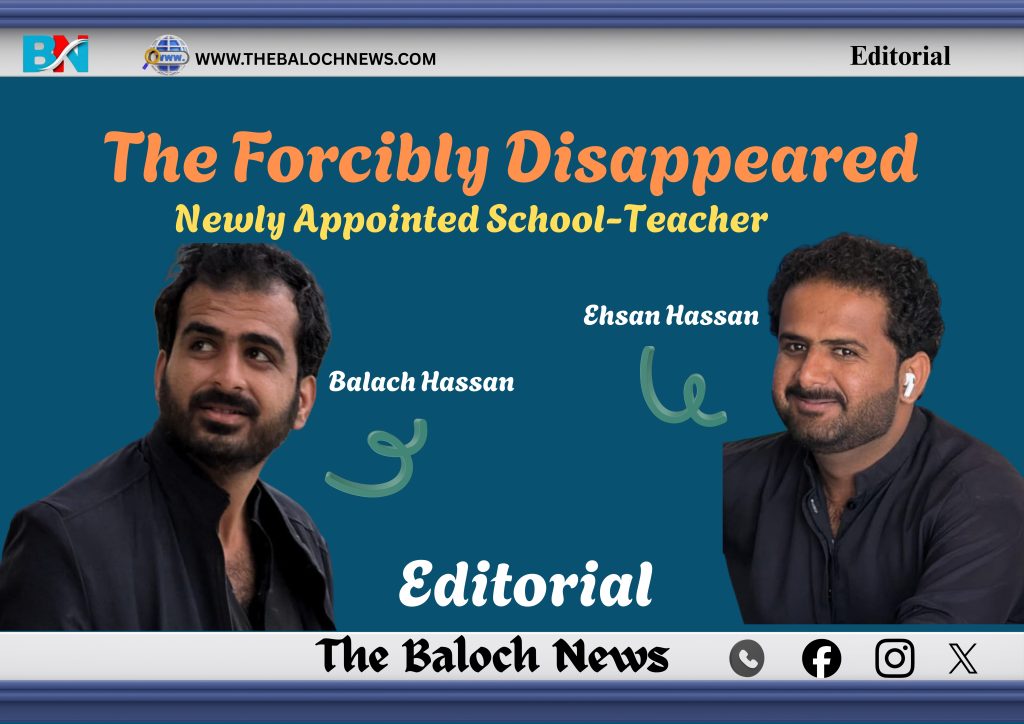
Balochistan’s educational concerns are unhidden with over 3 million children out-of-school. The very causes include ghost teachers with either “strong political background” or are forcibly disappeared by the security personnel – like thousands of other “illegally detained” Baloch. The very fresh case is of Balach Hassan, a newly-appointed Junior Vernacular Teacher (JVT), who is yet to receive his nomination letter and join one of the already deteriorating schools of his area in Jiwani, Gowadar.
Balach Hassan and his brother Ehsan Hassan (Ehsan is a mobile-shop owner despite being a graduate of the University of Turbat’s Biotechnology Department) were allegedly forcibly disappeared by the personnel of the notorious “Counter-Terrorism Department” on the midnight of January 21 and 22 at around 1. Since then, they have been shifted to an unknown location which is not even disclosed to their family. A day after their “illegal arrest and detention”, Balach was shortlisted for the post of JVT in the area to serve as a teacher in a school in Jiwani. For the very same purpose, he had to be physically present in the office of the District Education Officer to receive his nomination letter. But he is imprisoned in a location and under charges no one knows – or therefore he is forcibly disappeared because there are no actual charges against the duo.
Such detentions are not anew in Balochistan. For last three decades, enforced disappearances have tensed the indigenous people – tensed because the abductors are not veiled or unknown persons, but the law enforcement agencies themselves – ones who are to serve the law are going against them. Such disappearances, along with the personal sufferings of the detainees themselves and their families, also influence negatively the collective societal psyche. Because the abductors are not hidden to the local people, no matter what degree of “propaganda” has been used to term them “unknown armed men”, the people know them to the very core. Apart from a generation a sense of alienation, such detentions are tantamount to a direct attack on Balochistan’s education, integrity, stability and culture.
With already a large number of ghost teachers, Balochistan’s primary and public education hoped excellence with the fresher appointments, but when the same young teachers are fated illegal dungeons, the hope for a better education remains a bitter daydream. Alongside, the very important lives of the detainees being at risk which is even a harder nature of crime, Balach’s detention also hits the education fate of the society. The state institutions need to broadly revive their policies in Balochistan, particularly, concerning enforced disappearances. All in all, what Baloch actually need, and truly deserve, is a life – more and less, an existence that allows them to breathe.