


For a long time, Baloch society has lacked a strong and organized intellectual voice. Political groups often speak of this problem only without sufficient particular measures, while writers and scholars have mostly stayed away from real-life issues and everyday struggles of the people. Because of this gap, many false and anti-Baloch narratives have spread easily. In such a situation, people who try to use knowledge as a responsibility, not just as a personal skill, become very rare.
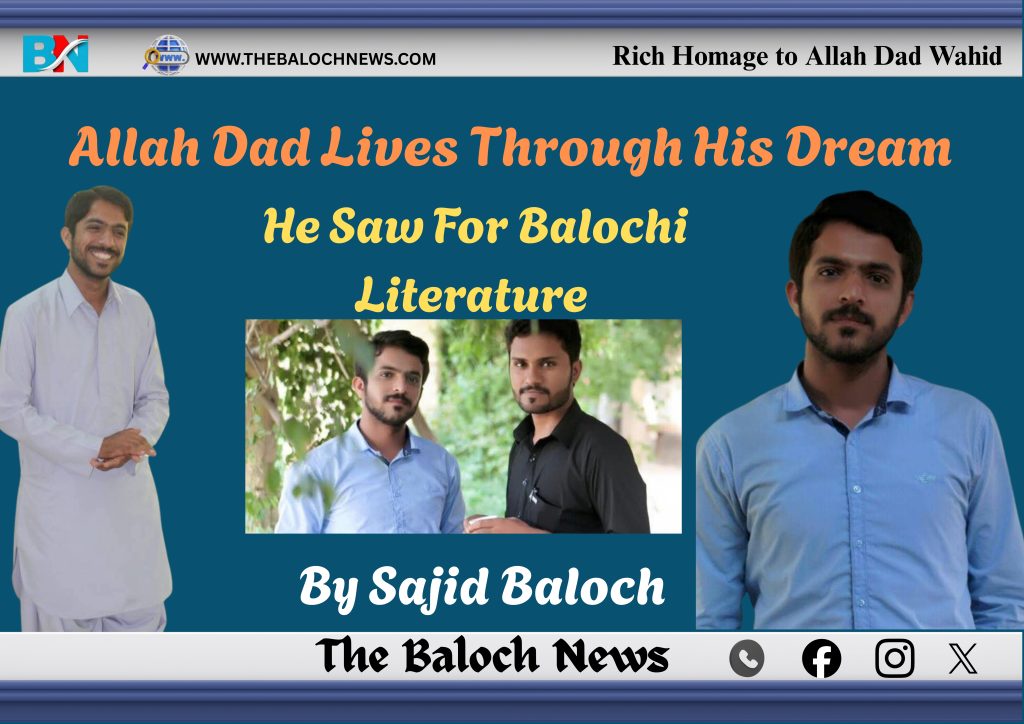
Allah Dad Wahid was one of those rare people. He was not just a student or a writer, but someone who believed that writing and knowledge should serve the society. For him, literature was not only about beautiful words—it was about the suffering stories of Baloch, awareness and the truth. He mostly focused on Balochi writings, because he felt that knowledge was meaningful only when people could read and understand it in their own language. Then they can evolve something and get their literature.
Allah Dad Wahid was born in Karachi and was a resident of Singanisar area of Turbat. He received his early education in Turbat and later studied at University of Karachi, and then Quaid-i-Azam University in Islamabad. Due to a sudden shift in the situations of Islamabad with Baloch-Pashtoon conflict, he came to Turbat and worked for his people.
After coming back, he realized that the main problem was not a lack of writers, but a lack of platforms. Many stories, experiences, and histories existed, but they were not written down. There were few institutions to support serious writing and research. Instead of working alone, he brought people together and encouraged collective efforts.
He worked closely with other writers and promoted serious writing in the Balochi language, especially on topics that had been ignored for years—such as law, history, colonialism, power, and resistance. His goal was to help build a culture of thinking, questioning, and learning.
Later, he found Dodman Publications. This was not just a publishing house; it was a mission. Through this platform, he worked to translate important English books and ideas into Balochi so that ordinary readers could also access global knowledge. He dreamed of a future where Balochi readers could study all major subjects in their own language.
Sadly, people who think, question, and spread awareness are often seen as a threat. On February 4, 2025, Allah Dad Wahid was martyred in Turbat. His killing was not an isolated incident. It was part of a wider pattern of extrajudicial killings targeting educated Baloch youth and intellectuals.
Allah Dad Wahid’s life reminds us that real strength of a society lies in knowledge, language, awareness and resistance. As long as people continue to read, write, and think in Balochi, his dream will live on. He is not just remembered as a person—but as a lasting idea. I owe him the dream he saw for us all.